
De Quervain's
Tenosynovitis
Jacksonville, FL
That sharp pain on the thumb side of your wrist — worse when you pick up your baby, lift a coffee cup, or turn a key — is one of the most common and most treatable wrist conditions in hand surgery. R. David Graham, MD treats De Quervain's tenosynovitis, including mommy thumb and nursemaid's wrist, in Jacksonville Beach with injection-first care and surgical release when needed.
- Sharp pain at the base of the thumb, on the wrist side
- Pain when lifting, pinching, or gripping
- Pain picking up an infant with thumbs up
- Swelling or a bump over the radial styloid
- Catching or snapping sensation when moving the thumb
- Pain with the thumb tucked in a fist and the wrist bent toward the small finger
De Quervain's is often confused with thumb basilar joint (CMC) arthritis — both cause thumb-side wrist pain. The distinction matters because treatment is different. Dr. Graham identifies which condition is present at the first visit.
- Pinpoint pain on the thumb side of the wrist — most patients point to it with one finger
- Usually diagnosed from the history and examination; imaging is rarely needed
- Often confused with thumb basilar joint arthritis, and the treatments are different
- Injection with a thumb-spica brace is first-line, and the injection is safe while breastfeeding
- A second injection may be considered before surgery when the first helped temporarily
- A separate EPB subcompartment is common, and Dr. Graham looks for it at every release
Understanding the Condition
The Tendons That
Run to Your Thumb
De Quervain's tenosynovitis is a stenosing condition of the first dorsal compartment on the thumb side of the wrist. The abductor pollicis longus (APL) and extensor pollicis brevis (EPB) tendons pass through a tight fibrous tunnel at the radial styloid. Thickening of the tendon sheath and surrounding retinaculum reduces the space available for the tendons to glide, producing pain, swelling and sometimes catching or crepitus.
Normally, these tendons glide smoothly through the compartment as the thumb moves. When the sheath and the retinaculum over it thicken — with repetitive thumb and wrist motion, hormonal changes, pregnancy, or for no identifiable reason — the tunnel narrows and the tendons can no longer glide freely. The result is pain, swelling, and sometimes a catching or squeaking sensation with thumb movement.
What makes De Quervain's distinctive is the precision of the pain location. It is not diffuse wrist pain — it is a specific, point tender area directly over the first dorsal compartment at the radial styloid, reproducible on examination with provocative testing of the APL and EPB tendons. Most patients can point to the exact spot with one finger.
The good news is that De Quervain's tenosynovitis responds well to treatment — frequently to injection alone, and to surgical release when injection is not sufficient.
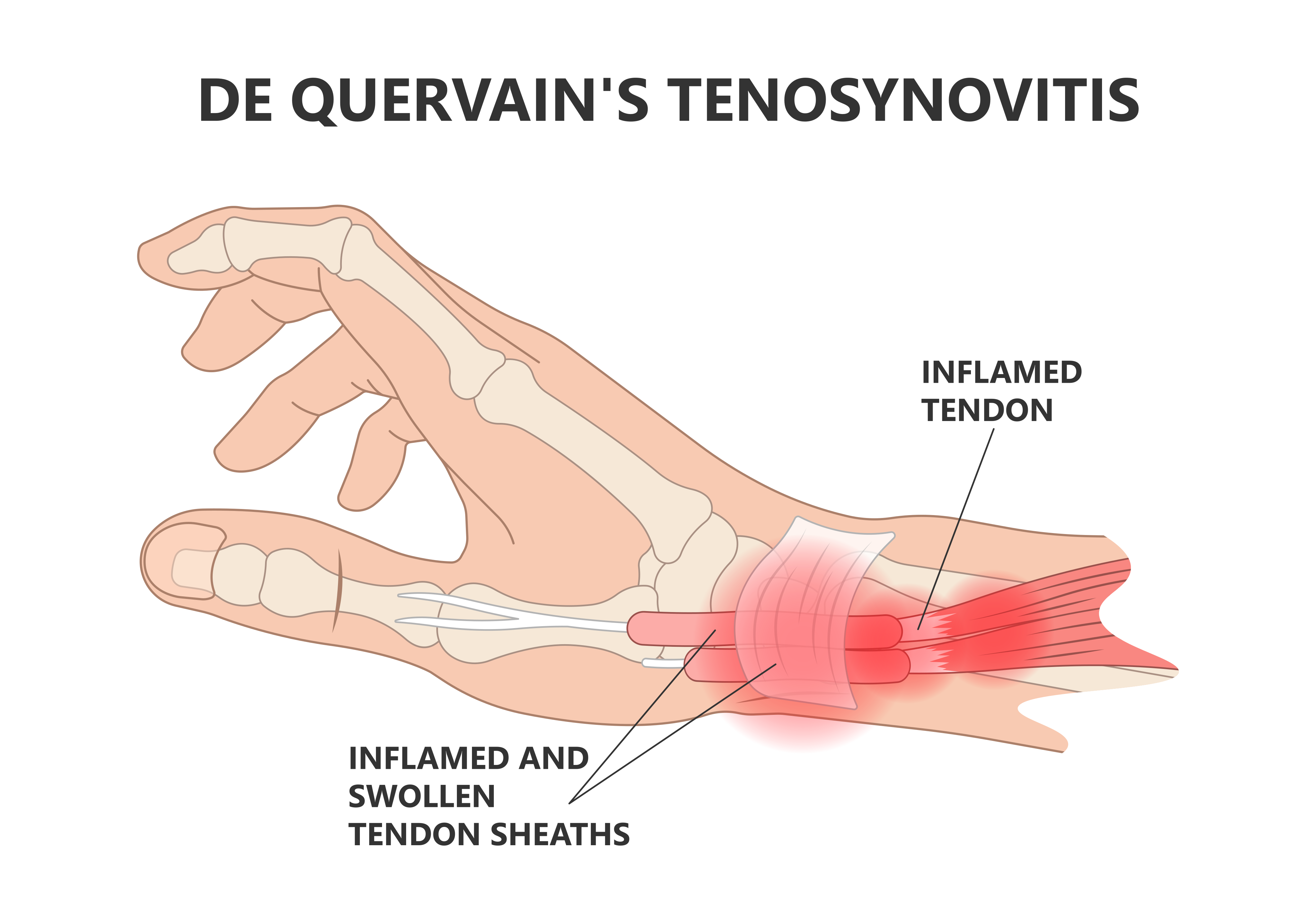
The APL (abductor pollicis longus) and EPB (extensor pollicis brevis) tendons pass through the first dorsal compartment together. In many patients, a fibrous septum divides the compartment into two sub-tunnels — the EPB runs in its own subcompartment.
This is clinically important: failure to identify a separate EPB subcompartment is a recognized cause of incomplete relief after De Quervain's surgery. Dr. Graham routinely looks for one and releases it when present.
Recognizing De Quervain's
De Quervain's Tenosynovitis Symptoms
The presentation is characteristic — most patients recognize themselves immediately in the description below.
Pinpoint Pain at the Wrist
Pain localized directly over the radial styloid — the bony prominence on the thumb side of the wrist. Patients can typically point to the exact spot with one finger. This precision distinguishes De Quervain's from more diffuse wrist conditions.
Pain Lifting or Carrying
Lifting with the thumb extended — picking up a baby, a grocery bag, a coffee cup, or a frying pan — loads the APL and EPB tendons directly and triggers sharp pain. Many patients first notice symptoms during routine lifting tasks.
Pain Turning or Twisting
Turning a key, opening a jar, wringing a towel, or rotating the wrist under load causes significant pain. Any motion that combines thumb abduction or extension with wrist deviation can trigger symptoms.
Swelling Over the Styloid
A visible or palpable swelling over the first dorsal compartment is common in acute or severe cases. Some patients describe a nodule or fullness on the thumb side of the wrist.
Catching or Snapping
As the tendons pass through the narrowed compartment, some patients notice a catching, snapping, or squeaking sensation — particularly with active thumb movement. This crepitus comes from the thickened tendon sheath rubbing against the fibrous roof of the compartment.
Persistent Aching at Rest
The wrist can keep aching well after the activity that set it off, particularly in new mothers who cannot reduce their lifting. In more symptomatic cases, aching can persist even at rest or at night.
A Common Presentation
Mommy Thumb &
Nursemaid's Wrist
De Quervain's tenosynovitis that develops in new parents — most commonly mothers, in late pregnancy or the first months after birth — has earned its own name: mommy thumb, or nursemaid's wrist. In Dr. Graham’s experience, it is one of the most common presentations of De Quervain's tenosynovitis, and it deserves its own discussion because the context creates specific challenges.
Why De Quervain's is so common during pregnancy and the postpartum period is probably multifactorial. Hormonal and fluid changes may affect the tendon sheath, while the repetitive wrist and thumb positions used to feed, lift and carry an infant add substantial mechanical demand.
The challenge for new mothers is that the aggravating activity cannot simply be avoided. You cannot put the baby down for six weeks. This makes conservative management more difficult — a splint helps, but it doesn't eliminate the loading. Corticosteroid injection is often particularly valuable in this population because it provides rapid, meaningful relief that allows a parent to function during the period of highest demand.
Typical Onset
Symptoms often begin during late pregnancy or the first several months after delivery, although timing varies.
Who Gets It
New mothers most commonly, but also fathers, grandparents, and nannies who are primary caregivers for a newborn. The repetitive mechanical loading associated with infant care can affect any caregiver.
Breastfeeding Safety
Corticosteroid injection into the first dorsal compartment is considered safe while breastfeeding. Local injections like this one require no special breastfeeding precautions. Discuss any concerns with Dr. Graham.
Does It Resolve on Its Own?
Sometimes — as lifting demands decrease in the first year of life, symptoms may gradually improve. However, waiting is not always practical or appropriate when pain is limiting infant care. Injection typically provides relief within days.
Return to Full Activity
Whether treated with injection or surgery, the goal is full return to infant care and all other activities. No long-term lifting restrictions apply after successful treatment.
Making the Diagnosis
Diagnosing De Quervain's
Tenosynovitis
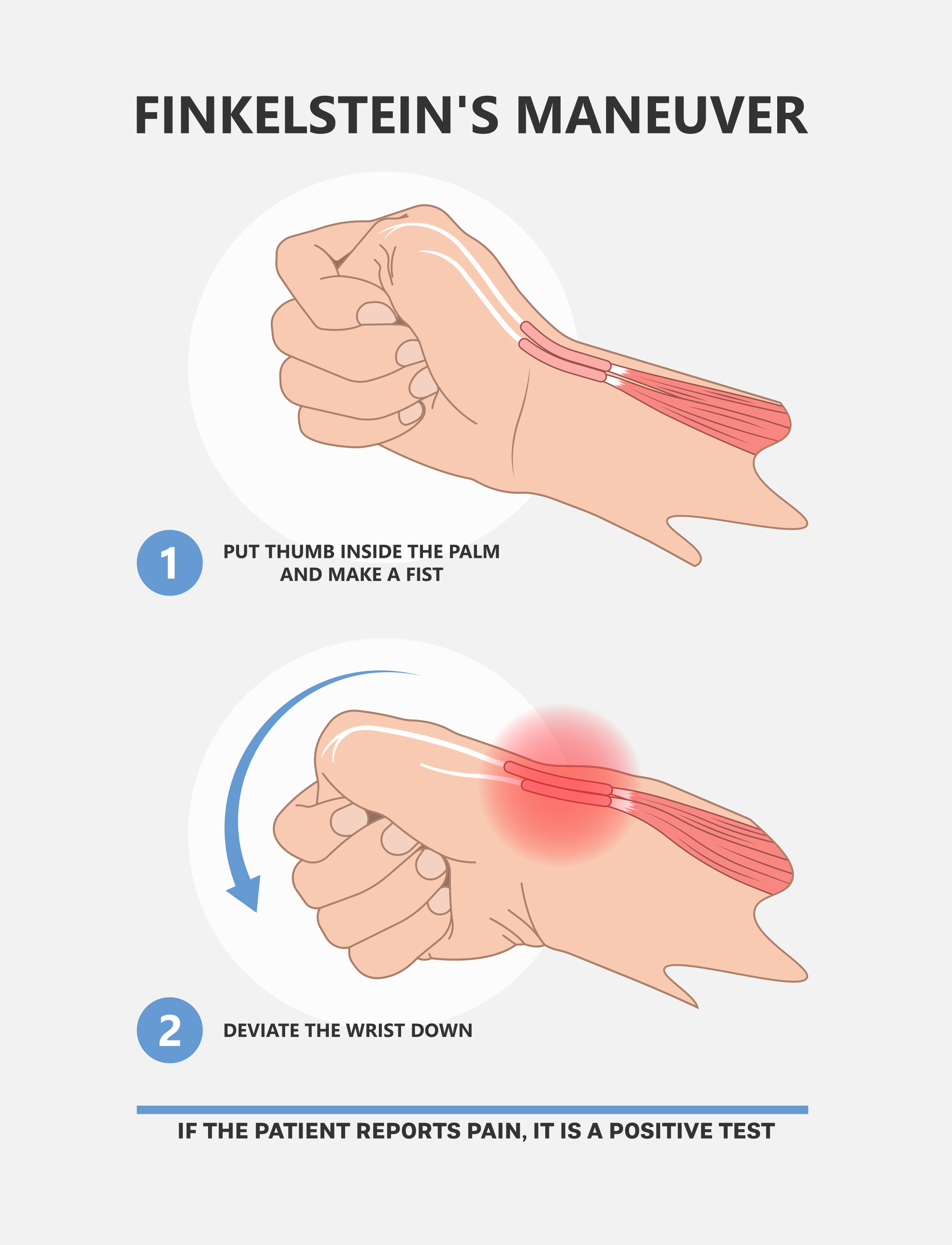
De Quervain's is usually diagnosed from the history and physical examination. Point tenderness over the first dorsal compartment at the radial styloid, together with pain reproduced by provocative testing of the APL and EPB tendons, strongly supports the diagnosis. Dr. Graham uses Finkelstein's test as part of the examination.
A meaningful response to a first dorsal compartment injection provides additional support for the diagnosis. A poor response does not by itself rule De Quervain's out: the medication may not have reached a separate EPB subcompartment, the anatomy may be unusual, a second source of pain may be present, or the stenosis may be advanced. It does prompt reconsideration of the diagnosis, particularly the possibility of CMC joint arthritis or intersection syndrome.
X-rays are not required to diagnose De Quervain's but may be obtained to rule out thumb CMC arthritis, a scaphoid fracture, or other bony pathology when the clinical picture is unclear. Ultrasound or MRI are rarely necessary.
Finkelstein's test places the thumb inside the fist and then moves the wrist toward the small-finger side. Pain directly over the first dorsal compartment may reproduce De Quervain's symptoms, but the maneuver is not diagnostic by itself.
Conservative Treatment First
De Quervain's Treatment: Injection, Splinting & Activity Modification
Surgery is rarely the first step. For most patients, Dr. Graham begins with corticosteroid injection combined with a thumb-spica brace. The brace is typically used for several weeks to reduce repetitive loading while the injection takes effect.
Corticosteroid Injection
A corticosteroid injection directly into the first dorsal compartment is a well-established first-line treatment for De Quervain's tenosynovitis. It reduces inflammation in the tendon sheath, providing relief that is often rapid — within days — and meaningful. In many patients, particularly those with early or moderate disease, a single injection resolves the condition. Dr. Graham first desensitizes the skin, then injects the corticosteroid together with local anesthetic — one procedure, with no separate numbing injection beforehand. Safe while breastfeeding.
Thumb Spica Brace
Immobilizing the thumb and wrist reduces repetitive loading of the irritated first dorsal compartment. Dr. Graham typically pairs the injection with a thumb spica brace, worn consistently during the day and at night for several weeks while the injection takes effect. A brace alone may provide relief, but corticosteroid injection is generally more effective when symptoms are established.
Activity Modification
Reducing or modifying activities that load the APL and EPB tendons — particularly lifting with the thumbs extended — reduces irritation of the tendons. For most patients this is partially achievable at best. New mothers caring for an infant cannot avoid the aggravating activity, which is why injection is particularly important in that population.
When Surgery Is Needed
De Quervain's Surgery: First Dorsal Compartment Release
Surgical release is a highly effective option for persistent De Quervain's after appropriate nonsurgical treatment. Published surgical series report substantial pain improvement in the large majority of appropriately selected patients.
Anesthesia
De Quervain's release is an outpatient procedure performed in the operating room. You choose the anesthesia. Most patients have local anesthesia with light sedation (MAC) or a regional block, and general anesthesia is rarely needed. Wide-awake surgery under local alone is possible but uncommon. The procedure takes approximately 20–30 minutes, and patients go home the same day.
Incision Over the Radial Styloid
A small transverse or slightly oblique incision is made directly over the first dorsal compartment at the radial styloid. The superficial radial nerve branches cross this area, and irritation or injury of these small sensory nerves is an important potential complication of De Quervain's surgery. Careful identification and protection of the superficial radial nerve branches reduces the risk of nerve injury.
First Dorsal Compartment Release
The fibrous roof of the first dorsal compartment is opened along its length, releasing the APL and EPB tendons. The tendons are confirmed to glide freely before proceeding. The compartment is inspected for any intracompartmental septum that separates the EPB into its own subcompartment.
Identify the EPB and Release Any Separate Subcompartment
Dr. Graham routinely identifies the EPB tendon and inspects the first dorsal compartment for a separating septum. When an EPB subcompartment is present, the septum is completely released so that both the APL and EPB tendons glide freely. Failure to identify a separate EPB compartment is a recognized cause of incomplete decompression and persistent symptoms after surgery.
Closure and Dressing
The incision is closed with absorbable sutures and a soft dressing is applied. Thumb and finger motion is encouraged immediately. Most patients notice meaningful improvement in pain within the first days to weeks after surgery. There are no stitches to remove; the dressing comes off at 10–14 days.
The EPB Subcompartment — Why It Matters
A separate EPB subcompartment is common in De Quervain's disease. Studies of surgical patients report septation in well over half of affected wrists, although published estimates vary. When present, a fibrous septum divides the first dorsal compartment into two distinct tunnels — the APL runs in the main compartment, and the EPB runs in its own subcompartment. If the subcompartment is not released during surgery, the EPB remains constricted and relief may be incomplete or temporary.
Failure to identify a separate EPB compartment is a recognized cause of incomplete decompression and persistent symptoms after surgery. Because a septum may only become apparent once the compartment is opened, Dr. Graham routinely identifies the EPB tendon and inspects for one at every release.
Recovery
What to Expect After De Quervain's Release
Recovery is generally relatively quick, although scar tenderness and superficial radial nerve sensitivity can take longer to settle in some patients.
Home the Same Day
Outpatient procedure. Small dressing applied. Thumb and fingers free to move immediately. Pain well-controlled with over-the-counter medications in most cases. Keep hand elevated.
Light Use, Keep Dry
Light hand and finger use permitted immediately. Keep the incision dry until the dressing comes off at 10–14 days. Many patients notice significant pain improvement within the first week.
Return to Most Activities
Dressing off, wound healed. Return to most daily activities including infant care. Grip strength and thumb motion improving. Incision scar maturing — some local tenderness normal.
Returning Toward Full Activity
Many patients have returned to unrestricted daily activity by this stage, with grip and pinch strength continuing to normalize. Manual work or particularly demanding activities may take longer depending on tenderness, strength and scar sensitivity.
De Quervain's or Thumb Arthritis?
An Important Distinction
De Quervain's tenosynovitis and thumb basilar joint (CMC) arthritis are frequently confused — both cause pain at the base of the thumb with gripping and lifting. The distinction matters because the treatments target different structures. De Quervain's involves the tendons; CMC arthritis involves the joint. Both can be present simultaneously, which is why a careful examination is essential.
Scroll the table sideways to see all columns
| Feature | De Quervain's Tenosynovitis | Thumb CMC Arthritis |
|---|---|---|
| Pain location | Over the radial styloid / first dorsal compartment | At the thumb base / CMC joint — slightly more distal |
| Provocative test | Pain with provocative testing of the APL and EPB tendons (Finkelstein's test) | Pain or crepitus with CMC grind testing (axial compression + rotation) may support the diagnosis |
| Tenderness | Point tender over the first dorsal compartment | Tender at the CMC joint; bony prominence may be visible |
| X-ray | Usually no abnormality attributable to De Quervain's | Joint space narrowing, osteophytes at CMC joint |
| Injection response | Relief with injection into first dorsal compartment | Relief with injection into CMC joint |
| Treatment | Splinting, injection, surgical release | Splinting, injection, suspensionplasty |
De Quervain's vs.
Intersection Syndrome
De Quervain's pain is centered at the radial styloid near the base of the thumb. Intersection syndrome causes pain and often crepitus several centimeters farther up the back of the forearm, where the first and second dorsal compartments cross. The location of maximal tenderness usually distinguishes the two conditions. Because the problem sits at a different spot, an injection aimed at the first dorsal compartment does not treat intersection syndrome, and the reverse is also true.
“Dr. Graham was extremely knowledgeable and professional. He helped me fully understand my operation and recovery. He did an amazing job with my operation and the scar left is better than I could have imagined.”
Biologic Treatment Option
Platelet-rich plasma has been studied as another nonsurgical treatment for De Quervain's tenosynovitis. Some small studies and systematic reviews have reported improvements in pain and function, including longer-term outcomes that may compare favorably with corticosteroid injection. However, the evidence remains limited and heterogeneous, and corticosteroid injection remains the better-established first-line injection treatment.
PRP is intended to deliver concentrated platelets and growth factors to the affected tissue in an effort to influence the local healing response.
Dr. Graham does not routinely recommend PRP before corticosteroid injection, but he is willing to discuss it with patients who have persistent symptoms and want to continue nonsurgical treatment before considering surgery. For complete information, see the PRP treatment page.
Common Questions
Frequently Asked Questions


Next Steps
That Wrist Pain
Is Treatable — Fast.
De Quervain's tenosynovitis — whether you've had it for weeks or years, whether you're a new mother or a longtime sufferer — responds well to treatment for most patients. A same-visit injection can provide rapid relief. When surgery is needed, recovery is generally relatively quick. Dr. Graham can evaluate and begin treating De Quervain's at your first visit.
Jacksonville Beach, FL 32250
Surgery days: Mon · Thu
De Quervain's can be evaluated, diagnosed, and injected at the first visit on clinic days. Walk-in access through JOI Now also available for urgent wrist pain.
References & Further Reading
The sources below informed this page and are good places to read further. Links open in a new tab.
- Challoumas D, Ramasubbu R, Rooney E, et al. Management of de Quervain Tenosynovitis: A Systematic Review and Network Meta-Analysis. JAMA Netw Open. 2023;6(10):e2337001.
- Abumadian AW, Binibrahim MI, Sultan AH, et al. The Use of Platelet-Rich Plasma for De Quervain's Tenosynovitis: A Systematic Review With Limited Meta-Analysis. Saudi Med J. 2026;47(8):1265–1276.
- He KS, He KS, Cheah A, et al. Unblinding de Quervain: A Systematic Review of Ultrasound-Guided Injection of Corticosteroids for Treatment of Stenosing Tenosynovitis of the 1st Extensor Compartment. J Med Radiat Sci. 2023;70(3):319–326.
- Bosman R, Duraku LS, van der Oest MJW, et al. Surgical Treatment Outcome of de Quervain's Disease: A Systematic Review and Meta-analysis. Plast Reconstr Surg Glob Open. 2022;10(5):e4305.
- Lee ZH, Stranix JT, Anzai L, Sharma S. Surgical Anatomy of the First Extensor Compartment: A Systematic Review and Comparison of Normal Cadavers vs. De Quervain Syndrome Patients. J Plast Reconstr Aesthet Surg. 2017;70(1):127–131.
- Avci S, Yilmaz C, Sayli U. Comparison of Nonsurgical Treatment Measures for de Quervain's Disease of Pregnancy and Lactation. J Hand Surg Am. 2002;27(2):322–324.
Medically reviewed by R. David Graham, MD · Reviewed 12 October 2026 · Board-Certified Orthopaedic Surgeon · Fellowship-Trained Hand & Upper Extremity Surgeon · Physician biography