
Thumb CMC
(Basal Joint)
Arthritis
Treatment, Denervation & Suspensionplasty in Jacksonville. The pinching and gripping pain at the base of your thumb has a name, and a range of treatments from splinting and injection to surgery. When surgery is needed, R. David Graham, MD performs suspensionplasty with Internal Brace and dermal allograft, which avoids harvesting your own FCR tendon and uses a removable brace instead of a cast. Fellowship-trained hand surgeon in Jacksonville Beach.
Understanding the Condition
What Is Thumb CMC
(Basal Joint) Arthritis?
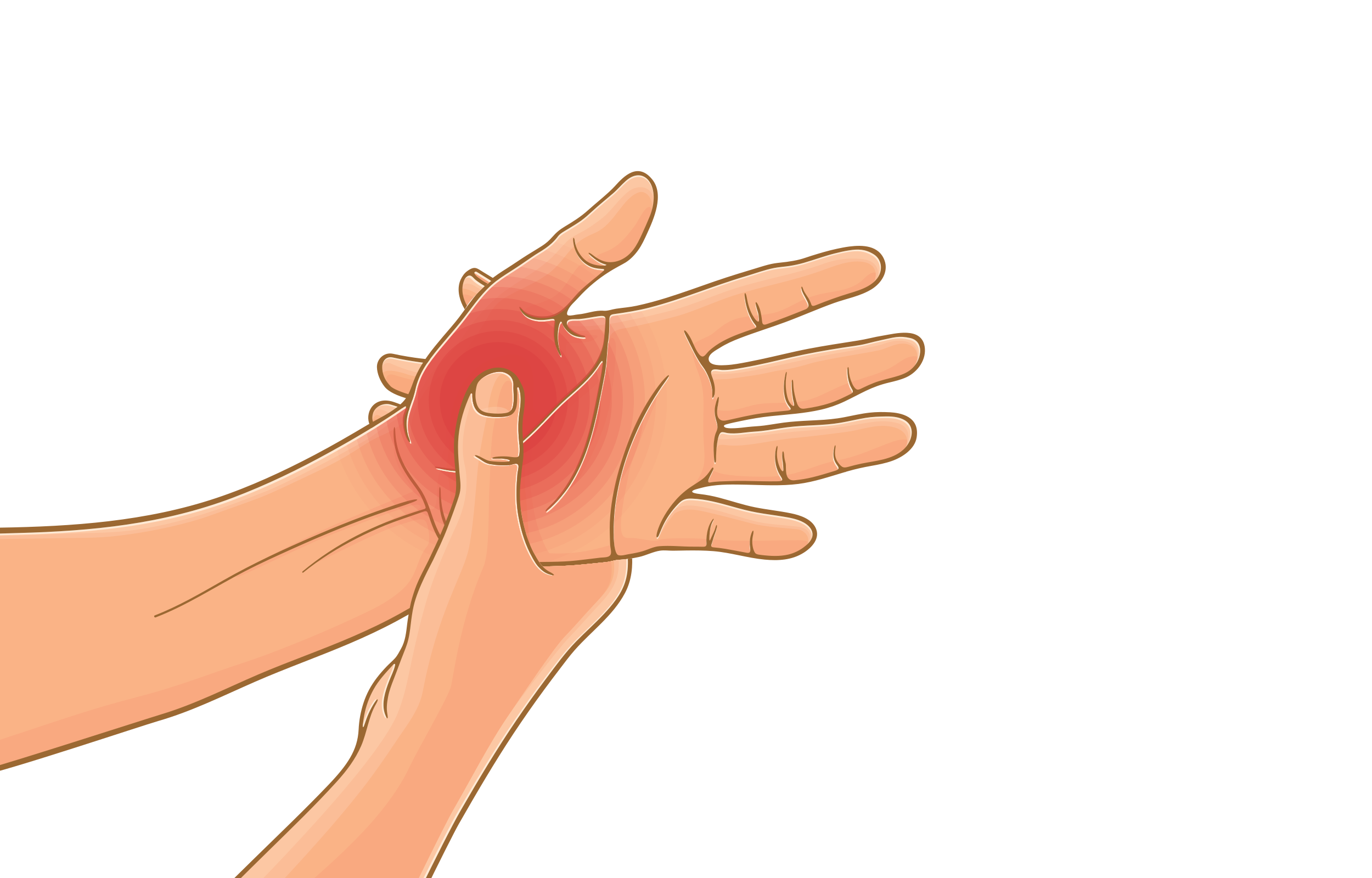
Thumb CMC arthritis — also called basal joint arthritis, basilar joint arthritis, or trapeziometacarpal arthritis — causes pain at the base of the thumb with pinching and gripping.
The thumb basilar joint — formally the carpometacarpal (CMC) joint — is where the thumb metacarpal meets the trapezium bone at the wrist. It is a saddle-shaped joint with an extraordinary range of motion: the thumb can flex, extend, abduct, adduct, and rotate in a full arc that allows opposition — the ability to touch the thumb to each fingertip — which is foundational to nearly every hand function humans perform.
That mobility comes at a cost. The CMC joint is one of the most mechanically loaded joints in the hand, bearing forces that can exceed ten times the pinching load during routine activities. Over decades, this loading wears the cartilage — and the joint develops arthritis. Thumb-base arthritis is one of the most common forms of arthritis in the hand, and it becomes increasingly common with age, particularly in women.
The result is a familiar pattern: pain at the base of the thumb with pinching and gripping, difficulty opening jars, weakness with writing or turning a key, and tenderness directly over the joint. In advanced cases, the thumb may develop a characteristic deformity — the metacarpal subluxes dorsally, the CMC joint collapses, and a compensatory hyperextension develops at the thumb MCP joint.
The good news: thumb CMC arthritis is very treatable. Many patients do well with splinting, activity changes and injection, and for those whose symptoms remain limiting, surgery can substantially improve pain and function. Many patients return to activities they had given up years earlier.
The trapezium — the arthritic bone shown in red — is removed entirely during suspensionplasty (trapeziectomy). The FCR tendon shown in green is preserved in Dr. Graham's technique, rather than harvested as graft material as in traditional LRTI.
The thumb metacarpal is then suspended and stabilized using an Internal Brace construct anchored with a dermal allograft, to keep the metacarpal from migrating proximally into the space left by the trapezium.
Recognizing the Problem
Thumb CMC Arthritis Symptoms
The symptoms are characteristic — most patients recognize their own experience in the list below. Onset is gradual and progressive.
Pain Opening Jars
The most commonly reported functional limitation. Pinching against resistance — jar lids, bottles, keys, doorknobs — loads the CMC joint directly and is typically the first activity that becomes painful.
Pain with Writing & Fine Motor Tasks
Writing, typing, sewing, using scissors, or any task requiring a sustained pinch grip triggers pain at the base of the thumb. Many patients describe having to stop mid-task and rest the hand.
Tenderness at the Base of the Thumb
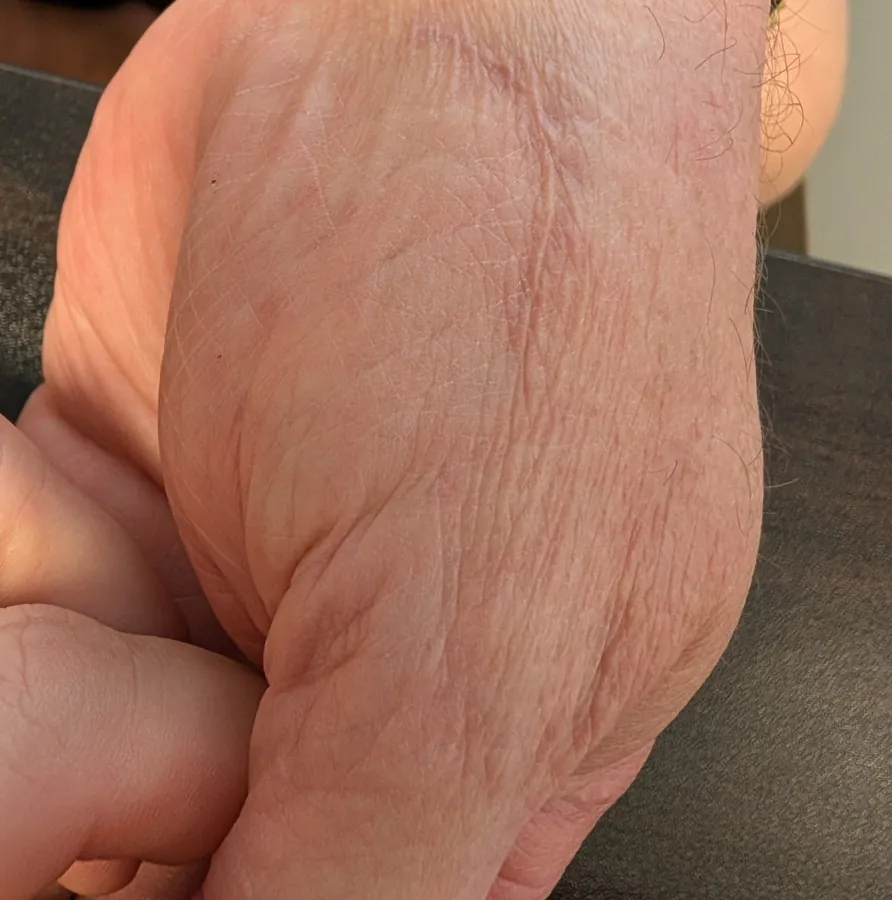
Direct pressure over the CMC joint — just below the thumb metacarpal where it meets the wrist — is exquisitely tender. Swelling and a bony prominence are often visible in more advanced cases.
Weak Pinch & Grip
Pinch strength is disproportionately affected — patients notice difficulty with tasks that used to be automatic. Grip strength also suffers as the thumb can no longer contribute normally to power grip.
Night Pain & Rest Aching
In more symptomatic arthritis, aching can occur at rest or wake patients at night.
Thumb Deformity
In advanced disease, the thumb metacarpal subluxes outward (dorsally), giving the hand a characteristic appearance. A compensatory hyperextension deformity at the thumb MCP joint often develops — this may require additional treatment at the time of surgery.
Diagnosis
How Thumb CMC Arthritis
Is Diagnosed & Graded
Diagnosis is usually based on the location of the pain, focal tenderness at the CMC joint, pain with pinch and provocative CMC testing, and X-rays showing the joint anatomy. MRI is rarely necessary for straightforward thumb CMC arthritis.
Dr. Graham also uses a diagnostic and therapeutic injection — a corticosteroid injected directly into the CMC joint — both to help identify the source of pain and to provide relief. A meaningful response to CMC injection provides additional support that the CMC joint is the primary pain generator.
The Eaton-Littler classification grades CMC arthritis from Stage I (early joint widening, no arthritic changes) to Stage IV (pan-trapezial arthritis involving the scaphotrapezial joint as well). At surgery, the stage helps identify whether the STT joint also needs attention.
X-rays show how much structural arthritis is present, but the X-ray does not determine whether someone needs surgery. Radiographic severity correlates poorly with how much pain and disability a patient experiences. Treatment is based primarily on symptoms, function, examination findings, and response to nonsurgical treatment.
Scroll to see the full table
Telling Them Apart
Thumb CMC Arthritis vs.
De Quervain’s Tenosynovitis
Both cause pain on the thumb side of the hand, and they are easy to confuse. De Quervain’s tenosynovitis is a problem of two tendons in a tight compartment at the wrist; thumb CMC arthritis is a problem of the joint at the base of the thumb.
Scroll to see the full table
| Thumb CMC arthritis | De Quervain’s | |
|---|---|---|
| Pain location | Base of thumb / CMC joint | Radial styloid (thumb side of the wrist) |
| Common trigger | Pinching, jars, keys | Thumb and wrist motion, lifting |
| Exam | CMC tenderness, pain with shear or grind testing | First dorsal compartment tenderness |
| X-ray | May show CMC arthritis | Usually no De Quervain’s-specific abnormality |
| Problem | Arthritic joint | APL/EPB tendon compartment |
Conservative Treatment First
Thumb CMC Arthritis Treatment: Splinting, Therapy & Injection
Surgery is not the first step. For mild to moderate thumb CMC arthritis, conservative treatment provides meaningful relief and is always tried before recommending surgery.
Thumb Spica Splint
Immobilizing the CMC joint in a resting position reduces inflammation and pain during flares. A custom thermoplastic splint worn at night — and during aggravating activities — is often the first intervention. Many patients get significant symptom control with a well-fitted splint and activity modification.
Activity Modification
Identifying and reducing pinch-loading activities provides relief. Jar openers, ergonomic tools, and technique modifications for writing or gripping can meaningfully reduce symptom burden. Occupational therapy is helpful in teaching joint protection strategies.
CMC Joint Injection
A corticosteroid injection directly into the basilar joint can provide temporary pain relief; the duration varies considerably among patients. Dr. Graham uses the injection both therapeutically and diagnostically — a meaningful response provides additional support that the CMC joint is the primary pain generator. When relief becomes short-lived and symptoms remain functionally limiting despite splinting, activity modification and other nonsurgical care, Dr. Graham begins discussing surgical options.
Choosing an Operation
Two Surgical Options Dr. Graham Offers: Denervation or Suspensionplasty
Dr. Graham offers two operations built on different ideas. Which one fits depends on the patient and the joint.
Thumb CMC Denervation: Keeping the Joint
Denervation leaves the joint in place and instead divides the small nerve branches that carry pain from it. Dr. Graham uses the dorsal (Wagner) approach, dividing branches of the lateral antebrachial cutaneous nerve, the palmar cutaneous branch of the median nerve and the radial sensory nerve, along with additional thenar branches of the median nerve.
It is a less commonly used option. Dr. Graham offers it mainly to active patients who want to keep the joint and are not ready for reconstruction, and he usually uses the response to a basilar joint injection to help decide whether it is likely to help.
It does not always work, and Dr. Graham says so up front. When it does, relieving the pain lets many patients regain grip strength that pain had been limiting, and most return to full activities in about six weeks. It often buys time.
Denervation offers a shorter recovery and preserves the joint, but its durability is less predictable than trapeziectomy-based reconstruction. Recent multicenter data found that approximately 28% of treated thumbs underwent another operation for recurrent symptoms over a median follow-up of 30 months. Importantly, denervation does not prevent a later suspensionplasty if pain returns.
Suspensionplasty: Rebuilding the Joint
Suspensionplasty removes the arthritic trapezium and stabilizes the thumb metacarpal. It is the operation Dr. Graham recommends for most patients, and the option when denervation is not a good fit or its relief has not lasted. His technique is described below.
Surgical Treatment
Thumb CMC Suspensionplasty: Dr. Graham's Technique
The goal of suspensionplasty is always the same: remove the arthritic trapezium and stabilize the thumb metacarpal. Surgeons differ in how they achieve that stabilization.
The traditional approach — ligament reconstruction with tendon interposition (LRTI) — harvests a strip of the flexor carpi radialis (FCR) tendon as the graft material. Half the FCR is divided, threaded through a bone tunnel in the thumb metacarpal, and anchored to reconstruct the ligament. The remaining FCR is anchored in the trapezium space as interpositional material. LRTI has decades of good outcomes, and patients do not generally become functionally limited by the harvest.
- Requires harvest of a portion of the FCR tendon, with the potential for donor-site morbidity
- Second incision for FCR harvest
- Generally longer operative time
Dr. Graham performs suspensionplasty using an Internal Brace construct — a suture tape anchored into the thumb metacarpal — combined with a dermal allograft anchovy-packed into the trapezium void. The FCR tendon is not harvested; it is left intact.
- FCR tendon left intact — no tendon harvest or donor site
- No second incision for tendon harvest
- Internal Brace provides immediate structural stability
- Dermal allograft fills the trapezium void as biological interpositional material
- No cast — removable Orthoplast thumb spica brace
Anesthesia
Suspensionplasty is performed under local anesthesia with sedation (MAC) or regional block. General anesthesia is rarely required. The procedure takes approximately 45–75 minutes. It is outpatient — patients go home the same day.
Trapeziectomy
The arthritic trapezium is removed through a carefully placed incision over the base of the thumb. Complete removal of the trapezium eliminates the arthritic joint surface entirely — this is the most important step for achieving pain relief and is performed in every case. The FCR tendon, which runs immediately beneath the trapezium, is identified and preserved throughout.
Internal Brace Suspension
With the trapezium removed, the thumb metacarpal must be prevented from migrating proximally (settling into the void) and from subluxing. An Internal Brace construct — a suture tape anchor — is placed through the base of the thumb metacarpal and secured to maintain the metacarpal in proper position. This suspends the thumb from the start, without depending on a harvested tendon graft.
Dermal Allograft Anchovy
A dermal allograft — donor connective tissue — is tightly rolled (anchovy technique) and packed into the trapezium void. This interpositional material fills the space, provides a biological cushion, and incorporates over time as a soft tissue spacer. Because it is allograft, it provides interpositional tissue without requiring harvest of the patient's FCR tendon. Small comparative studies have reported similar short-term clinical outcomes to FCR-based LRTI, although larger comparative studies are still needed.
Closure & Brace Application
The incision is closed and a custom Orthoplast thumb spica brace is fabricated. There is no plaster or fiberglass cast. The brace is removable, adjustable as swelling changes, and allows skin hygiene during the recovery period. Hand therapy begins within the first week to begin gentle thumb motion within the brace.
No Cast — A Removable Orthoplast Brace Instead
Dr. Graham does not routinely use a plaster or fiberglass cast after his suspensionplasty. Instead, patients transition to a custom removable thermoplastic (Orthoplast) thumb-spica brace, allowing hygiene, swelling adjustment and controlled early motion. It can be cleaned and adjusted without a clinic visit. In Dr. Graham’s experience, patients consistently describe the removable brace as one of the most appreciated parts of their recovery.
When More Is Needed
Additional Procedures Performed at the Same Surgery
Some patients have additional pathology at the time of thumb CMC reconstruction. When they are significant, Dr. Graham can address them at the same operative setting.
In Stage IV basilar joint arthritis, the scaphotrapeziotrapezoid (STT) joint — the articulation between the scaphoid, trapezium, and trapezoid — is also arthritic. Not every STT change seen on X-ray causes symptoms.
When clinically meaningful STT arthritis is present, Dr. Graham may perform partial trapezoid excision with interposition at the same setting to address the remaining scaphotrapezoid articulation.
This is a nuanced intraoperative decision that requires recognition of the STT joint's contribution to the patient's symptoms — the kind of judgment that comes from fellowship training and focused experience with CMC arthritis reconstruction.
As basilar joint arthritis progresses, the thumb develops a compensatory deformity at the MCP (knuckle) joint — the thumb hyperextends to compensate for the collapsing CMC joint. Significant hyperextension can persist after the CMC joint is reconstructed and affect tip pinch.
Significant or functionally important MCP hyperextension may require an additional procedure. In selected patients, Dr. Graham performs thumb volar plate capsulodesis to improve pinch posture — tightening the volar (palm-side) plate of the MCP joint to limit hyperextension.
Recovery
What to Expect After Suspensionplasty
Recovery is progressive and slow. Most patients notice meaningful pain improvement well before strength returns, and strength continues to improve for many months.
Brace & Rest
Orthoplast thumb spica brace worn continuously. Incision healing. Fingers are free to move. Swelling managed with elevation. Hand therapy evaluation and gentle finger exercises begin.
Protected Motion
Absorbable sutures; dressing off at 10–14 days. Gentle thumb motion begins within the brace. Light activities of daily living permitted. Brace can be removed for hygiene and therapy exercises.
Strengthening
Brace discontinued. Progressive pinch and grip strengthening with hand therapy. Many patients are managing daily activities with fewer restrictions. Pain is usually much improved by this point, while strength is still recovering.
Returning Toward Full Activity
Many patients are back to most daily activities during this period, but pinch and grip strength are still improving. Heavy manual work and demanding sports may take longer.
Final Strength & Recovery
Strength and function can continue improving for many months after surgery. Most of the long-term result becomes apparent over the first year.
Everyday Life
Activities Commonly Limited by Thumb CMC Arthritis
These activities do not necessarily cause thumb arthritis. They often expose it, because they require sustained pinch, grip or thumb opposition.
Postmenopausal Women
Thumb-base arthritis becomes increasingly common with age and is more prevalent in women. Hormonal and ligament-laxity mechanisms have been proposed as contributors to the female predominance, but the biology is not completely settled. Many patients have adapted around the pain for years before seeking evaluation.
Golfers & Racquet Sports Players
Golfers, tennis players, and pickleball players grip hard through every swing. Pinching the club, grip tension through impact, and the rotation of a golf swing or racquet stroke all load the basilar joint, which is why the sport is often where the pain shows up first. Getting back to play is a common goal of treatment.
Musicians
Guitarists, pianists, and string players rely on sustained pinch, so thumb-base arthritis can affect their ability to play — and sometimes their career. That makes it a high-stakes diagnosis, and precise recovery of pinch mechanics is the goal of treatment.
Manual Workers & Tradespeople
Carpenters, plumbers, electricians, and others who use their hands for heavy work feel thumb arthritis every time they grip a tool. Return to work is a primary goal and is often achievable, although heavy manual work can take longer to return to after surgery.
Computer Users & Writers
Sustained mouse use, keyboard work, and extended writing keep the thumb pinching for hours each day. These patients often notice symptoms earlier, and the functional impact is significant because they cannot avoid the aggravating activity.
Crafters, Artists & Gardeners
Knitting, sewing, painting, pottery, and gardening all require fine pinch control and sustained grip. The thumb arthritis patient who can no longer knit or garden has lost a meaningful source of joy, and getting back to it is one of the most rewarding goals of treatment.
Patient Experiences
In Their Own Words
“I have arthritis in my thumbs and Dr. Graham did surgery on my right hand. Surgery was a couple of months ago and I am pain free now! I have to workon building the strength back up, but the constant aching is gone!”
“It’s wonderful to be able to use my thumb and not have pain. Thank you Dr Graham I highly recommend him to anyone who is having issues with there hands .”
Biologic Treatment Option
PRP has emerged as another nonsurgical option for symptomatic thumb CMC arthritis. Early studies and recent systematic reviews report encouraging improvements in pain and pinch function, but the evidence base remains relatively small and treatment protocols vary. A 2025 double-blind, placebo-controlled trial found that a single PRP injection relieved pain no better than a saline injection at six months. PRP has not been proven to regrow cartilage or slow the structural progression of arthritis.
Dr. Graham discusses PRP with patients who want to continue nonsurgical treatment before considering surgery, particularly when relief from corticosteroid has been temporary. See the PRP treatment page for full procedure details.
Common Questions
Frequently Asked Questions
References & Further Reading
The sources below informed this page and are good places to read further. Links open in a new tab.
- Bhat S, Weeda L, Seth I, Rozen WM. Comparison of Surgical Techniques and Joint Injections for Base of Thumb Osteoarthritis: A Systematic Review. J Hand Surg Glob Online. 2025;7(2):212–218.
- Hones KM, Rakauskas TR, Childers J, et al. Surgical Management of Thumb Carpometacarpal Arthritis: A Systematic Review of Trapeziectomy, Suspension, and Arthroplasty Procedures over the Last 20 Years. J Hand Microsurg. 2026;18(6):100509.
- Graesser EA, Calfee RP, Boyer MI, et al. A Prospective Randomized Pilot Study: One-Year Outcomes of Ligament Reconstruction Tendon Interposition Versus Suture Tape Suspensionplasty for Thumb Carpometacarpal Joint Arthritis. J Hand Surg Am. 2024;49(10):955–965.
- Choi SW, Bae JY, Lee HJ, et al. Surgical Outcomes of Suspension Arthroplasty with Dermal Allograft Interposition after Trapeziectomy: Comparison with Ligament Reconstruction and Interposition Using the Flexor Carpi Radialis Tendon. Clin Orthop Surg. 2025;17(2):317–323.
- Nieuwdorp NJ, Blaaker C, Kwee E, et al. Is Joint Denervation a Durable Treatment for Thumb Carpometacarpal Osteoarthritis? A Multicenter Long-Term Outcome Study. Plast Reconstr Surg. 2026;158(3S):40S–51S.
- Tossini NB, Melo CS, Braz de Oliveira MP, et al. Effect of Physical Therapy Interventions in Individuals with Primary Thumb Carpometacarpal Osteoarthritis: A Systematic Review and Meta-Analysis. Disabil Rehabil. 2024;46(26):6251–6265.
- El Sewify O, Datta S, Legler J, et al. Safety and Efficacy of Platelet-Rich Plasma Injections in Basal Thumb Osteoarthritis; Should We Offer It or Not? J Hand Microsurg. 2025;17(3):100223.
- Evans K, von Kieseritzky J, Stenseth J, Wilcke M. Platelet-Rich Plasma Injection for Painful Trapeziometacarpal Osteoarthritis: A Double-Blind, Randomized, Placebo-Controlled Trial. JB JS Open Access. 2025;10(2):e25.00027.


Next Steps
That Thumb Pain
Is Fixable.
Thumb basilar joint arthritis is very treatable, with or without surgery. A consultation with Dr. Graham starts with understanding your goals — what activities you want to return to, what non-surgical treatment you have already tried, and what your X-rays show. From there, the path forward is clear.
Jacksonville Beach, FL 32250
Surgery days: Mon · Thu
Walk-in evaluation through JOI Now available Monday–Friday. Thumb pain that has been building for months can often be assessed and a plan made at the first visit.