
Trigger Finger
Treatment
Jacksonville, FL
That clicking, catching, or locking finger has a simple explanation — and a reliable fix. R. David Graham, MD offers trigger finger treatment in Jacksonville Beach, including in-office release under local anesthesia for eligible patients. No hospital. No sedation. Home within the hour.
For eligible patients, trigger finger release is a routine in-office procedure under local anesthesia. Eligibility confirmed at consultation.
- Catching, popping, or locking as the finger bends — sometimes needing the other hand to straighten it
- The A1 pulley at the base of the finger has thickened; the tendon can no longer glide through it
- Diagnosed on examination — no MRI, no nerve study, no blood test
- Injection resolves many mild to moderate cases
- Release is available in the office under local anesthesia — no IV, no sedation, home within the hour
- The locking is gone the moment the pulley is released, often while the patient watches
Understanding the Condition
What Is Trigger Finger?
Trigger finger — medically called stenosing tenosynovitis — is a condition where a finger catches, pops, or locks as it bends and straightens. In some cases the finger can become stuck in a bent position and require the other hand to straighten it. In others it snaps painfully through a tight point. The thumb is equally susceptible, in which case it's often called trigger thumb.
The underlying problem is a mismatch between the flexor tendon and the sheath it runs through. The A1 pulley — a small ring of tissue at the base of the finger where it meets the palm — becomes thickened and tight. The tendon has to squeeze through a space that is too narrow, creating that characteristic catching or triggering sensation. A nodule can form on the tendon itself, making the problem worse.
No special imaging is required to diagnose trigger finger. The diagnosis is clinical — Dr. Graham can identify it on examination immediately. There is no nerve conduction study, no MRI, and no blood test required. If your finger clicks, pops, catches, or locks, you likely have trigger finger.
It is one of the most common hand conditions treated in a hand surgery practice — and one of the most satisfying to fix. The catching and locking resolve immediately when the pulley is released.
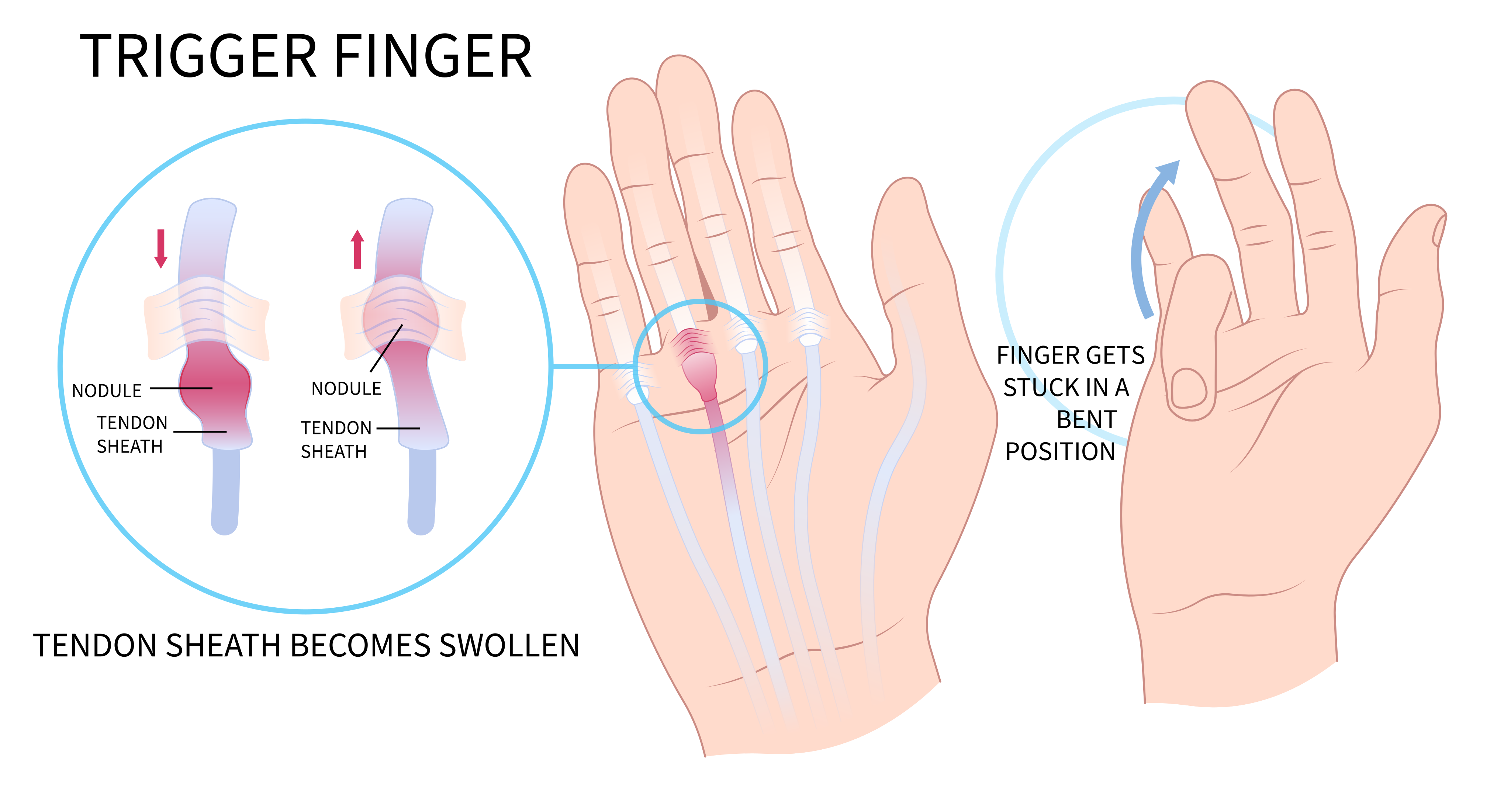
The A1 pulley acts like a tunnel that keeps the flexor tendon pressed against the bone as you bend your finger. When it thickens — from inflammation, repetitive stress, or unknown causes — the tendon can no longer glide smoothly through it.
Trigger finger release divides this tight pulley, restoring smooth tendon gliding. The procedure is straightforward, reliable, and curative in the vast majority of patients.
Who Gets Trigger Finger
Trigger Finger Risk Factors
Trigger finger can affect any finger on either hand, and multiple fingers can be affected simultaneously. Certain conditions increase the likelihood.
Diabetes
Patients with diabetes have a significantly higher risk of trigger finger — and are more likely to have multiple fingers affected simultaneously. The condition often presents differently in diabetic patients, and injection may be less successful — particularly with more advanced or systemic diabetic disease.
Repetitive Gripping
Repetitive or forceful gripping can aggravate symptoms in some patients, although trigger finger frequently develops without a specific repetitive activity or identifiable cause.
Rheumatoid Arthritis
Inflammatory arthritis affects the tendon sheath and surrounding structures. Trigger finger is a recognized complication of rheumatoid arthritis and may occur alongside other hand manifestations of the disease.
Female Sex
Trigger finger is more common in women than in men — roughly three times as common. The reason is not fully understood but may relate to differences in tendon sheath anatomy and hormonal factors.
Age
Most commonly diagnosed between ages 40 and 60, though it can occur at any age. Pediatric trigger thumb — a distinct condition — can present in young children and has a different natural history and management approach.
Associated Conditions
Carpal tunnel syndrome, Dupuytren's contracture, and De Quervain's tenosynovitis all occur more frequently in patients with trigger finger — suggesting a shared underlying predisposition in some individuals.
Trigger Finger Symptoms & Severity
| Grade | What You Feel & Typical Treatment |
|---|---|
| I — Mild |
Pain and tenderness at the base of the finger. No catching or locking yet.
Splinting, activity modification, observation
|
| II — Moderate |
Catching or snapping sensation with active motion. Finger unlocks on its own.
Corticosteroid injection is often the first step
|
| III — Severe |
Finger locks and requires passive manipulation (other hand) to straighten.
Injection or release depending on duration, stiffness, prior treatment, and patient preference
|
| IV — Fixed |
Finger is locked in a fixed position and cannot be passively straightened.
Release is usually recommended — in-office for eligible patients
|
Treatment Options
Trigger Finger Treatment Options
Treatment depends on severity, duration of symptoms, prior treatment history, and patient preference. Dr. Graham discusses all options at your consultation.
A corticosteroid injection into the flexor tendon sheath reduces inflammation around the A1 pulley and often resolves symptoms completely — particularly in mild to moderate cases (Grade I–II) or in patients with early-onset trigger finger.
In Dr. Graham's experience, the patients who do best with injection alone are those seen before the finger has begun locking in a fixed position — which is why he offers injection first rather than moving straight to release. Success rates are good for a first injection. A second injection may be offered if there is a partial response. Injection may be less successful in some patients with diabetes, particularly those with more advanced or systemic diabetic disease, and recurrence is more common — surgical release is often the more reliable path.
- Performed in the office at the time of consultation in many cases
- Relief often begins within days
- Most patients return to normal activities immediately
- May be less successful with more advanced diabetes, or with long-standing trigger finger
- Surgical release recommended if injection fails or symptoms recur
Surgical release of the A1 pulley is the definitive treatment for trigger finger. The pulley is divided under local anesthesia through a small incision at the base of the finger — restoring smooth tendon gliding. Dr. Graham checks that the tendon glides freely before the procedure is completed.
For eligible patients, this is performed right here in the office. No hospital admission, no IV, no sedation required, no antibiotics. The procedure takes approximately 15 minutes. Most patients leave the office moving the finger freely.
- In-office local anesthesia for eligible patients
- ~15 minute procedure, ~1 hour total visit
- Fingers free to move immediately after
- Highly reliable — true recurrence after complete release is uncommon
- Multiple fingers can often be addressed at the same visit
The Same Fix. Without the Hospital.
For most patients with trigger finger, there is no medical reason to go to a hospital or surgery center for this procedure. Dr. Graham performs trigger finger release in the office under local anesthesia — the finger is numb within minutes, and Dr. Graham completes the release. No IV, no sedation, no antibiotics, no recovery room.
What to Expect
What to Expect During In-Office Trigger Finger Release
For patients having an in-office trigger finger release, here is what the experience looks like from arrival to discharge.
You Arrive
Check in at the office. No fasting required — eat and drink normally. You are called back promptly. The procedure room is within the office suite.
Local Anesthetic
Local anesthetic is injected at the base of the finger. Brief discomfort, then the area is completely numb within a few minutes.
Release — 15 Minutes
Dr. Graham makes a small incision, divides the tight A1 pulley, and checks that the finger now glides freely. Many patients ask to watch — and do. The locking is gone at this moment.
Home Within the Hour
A small dressing is applied. You leave with your fingers moving freely. Brief recovery check, then discharged. Dr. Graham's team will follow up with you that evening.
After Surgery
Recovery After Trigger Finger Release
Recovery is typically fast and straightforward. Most patients are pleasantly surprised by how quickly they regain normal hand function.
Catching Is Gone
Mechanical catching and locking typically resolve immediately after complete A1 pulley release. Fingers are free to move straight away. Stiffness or loss of extension that developed before surgery may take longer to improve. Small dressing in place. Keep the area clean and dry.
Light Activity
Most patients use the hand for light activities within days. Some swelling and soreness at the incision site is normal. Keep the dressing dry until sutures are removed.
Sutures Out
Sutures removed at approximately 10–14 days. The small incision heals quickly. Hand therapy is rarely needed after straightforward trigger finger release.
Strength Continues to Improve
Most patients are back to routine hand use within several weeks. Grip strength and incision tenderness continue to improve over the following weeks to months, and recovery may take longer when significant stiffness was present before surgery. Scar at the base of the finger fades over several months. Recurrence after complete surgical release is uncommon.
Patient Experiences
In Their Own Words
“Dr Graham has taken care of our son’s broken hand and recently did surgery to release my trigger thumb 👍. He has a very pleasant bedside manner and extremely knowledgeable of his craft. He took his time explaining and answered my questions.”
“The rapport he has with his staff and colleagues creates a comfortable experience both in the office and surgery center. He is a talented and confident surgeon. The outcome of my surgery was fantastic, I would highly recommend Dr. Graham to family and friends.”
“Dr. Graham put me at complete ease at my consultation for my locked trigger thumb. Surgery day was quick and easy and I appreciated that he called me that evening on his way home to check on me. Follow up visit was easy and pain free!”
“I highly recommend Dr. Graham based on my own personal experience. I recently had Dr. Graham perform a trigger finger release procedure. I was very happy with Dr. Graham and his team from start to follow-up.”
Common Questions
Frequently Asked Questions


Next Steps
That Finger Doesn't Have to
Click Anymore.
Trigger finger is one of the most straightforward conditions in hand surgery to treat — and one of the most immediately satisfying for patients. For most patients, this can happen in the office, on a clinic day, without a hospital visit.
Jacksonville Beach, FL 32250
Surgery days: Mon · Thu
Walk-in access available through JOI Now, Monday–Friday. Trigger finger is a condition Dr. Graham can often evaluate and begin treating at the same visit.
References & Further Reading
The sources below informed this page and are good places to read further. Links open in a new tab.
- American Academy of Orthopaedic Surgeons. Trigger Finger (Trigger Thumb) — OrthoInfo patient guide. AAOS.
- American Society for Surgery of the Hand. Trigger Finger — HandCare patient information. ASSH.
- Gil JA, Hresko AM, Weiss APC. Current Concepts in the Management of Trigger Finger in Adults. J Am Acad Orthop Surg. 2020;28(15):e642–e650.
- Currie KB, Tadisina KK, Mackinnon SE. Common Hand Conditions: A Review. JAMA. 2022;327(24):2434–2445.
Medically reviewed by R. David Graham, MD · Reviewed 26 September 2026 · Board-Certified Orthopaedic Surgeon · Fellowship-Trained Hand & Upper Extremity Surgeon · Physician biography