
Tennis Elbow —
Lateral Epicondylitis
Jacksonville, FL
Tennis elbow is primarily a degenerative tendon condition rather than classic inflammation. It usually develops from cumulative loading of the common extensor tendon and can persist for months. Dr. Graham's approach is comprehensive and stepwise. Rehabilitation, cortisone, PRP, and surgery when needed — with the goal of providing as much relief as possible for as long as possible.
- Lateral elbow pain with gripping, lifting, turning doorknobs
- Primarily a degenerative tendon condition, not classic inflammation
- Usually improves with time — about 9 in 10 people are substantially better by one year
- Diagnosed by history and examination — imaging only when it will change the plan
- Progressive rehabilitation is the foundation of nonsurgical treatment — cortisone and PRP are injection options depending on severity and goals
- Surgery is an option for persistent, function-limiting symptoms
You don't have to play tennis to get tennis elbow. Most patients are manual workers, office workers, or recreational athletes who have never held a racket.
Understanding the Condition
What Is Tennis Elbow —
and Why Is It
Such a Tough Problem?
Tennis elbow — lateral epicondylitis — is chronic degeneration of the extensor carpi radialis brevis (ECRB) tendon at its origin on the lateral epicondyle of the humerus. Despite the name "epicondylitis," this is not primarily an inflammatory condition. Biopsy studies show degenerative changes in the tendon tissue — angiofibroblastic tendinosis — rather than the inflammatory cells you would expect with true "-itis." The tendon is wearing down, not inflaming.
This distinction matters for understanding treatment. Anti-inflammatory medications and cortisone injections may reduce pain in the short term, but they are not addressing the underlying degenerative process. The tendon has to heal on its own — and degenerated tendon tissue is not efficient at doing that.
The ECRB tendon is loaded every time the wrist is extended against resistance — which happens constantly during gripping, lifting, turning, and carrying. Its origin on the lateral epicondyle is a high-stress mechanical junction. Repetitive loading over years comes from work, sport, or daily activity. The tendon can develop disorganized collagen and degenerative change when repeated loading exceeds its ability to adapt and recover. The result is a degenerative tendon that hurts with use and is slow to recover.
In Dr. Graham's experience, the single most reassuring thing he can tell patients is also the most accurate: this condition almost always gets better eventually. The goal of treatment is to reduce symptoms, maintain function and help the patient through the natural course of the condition.
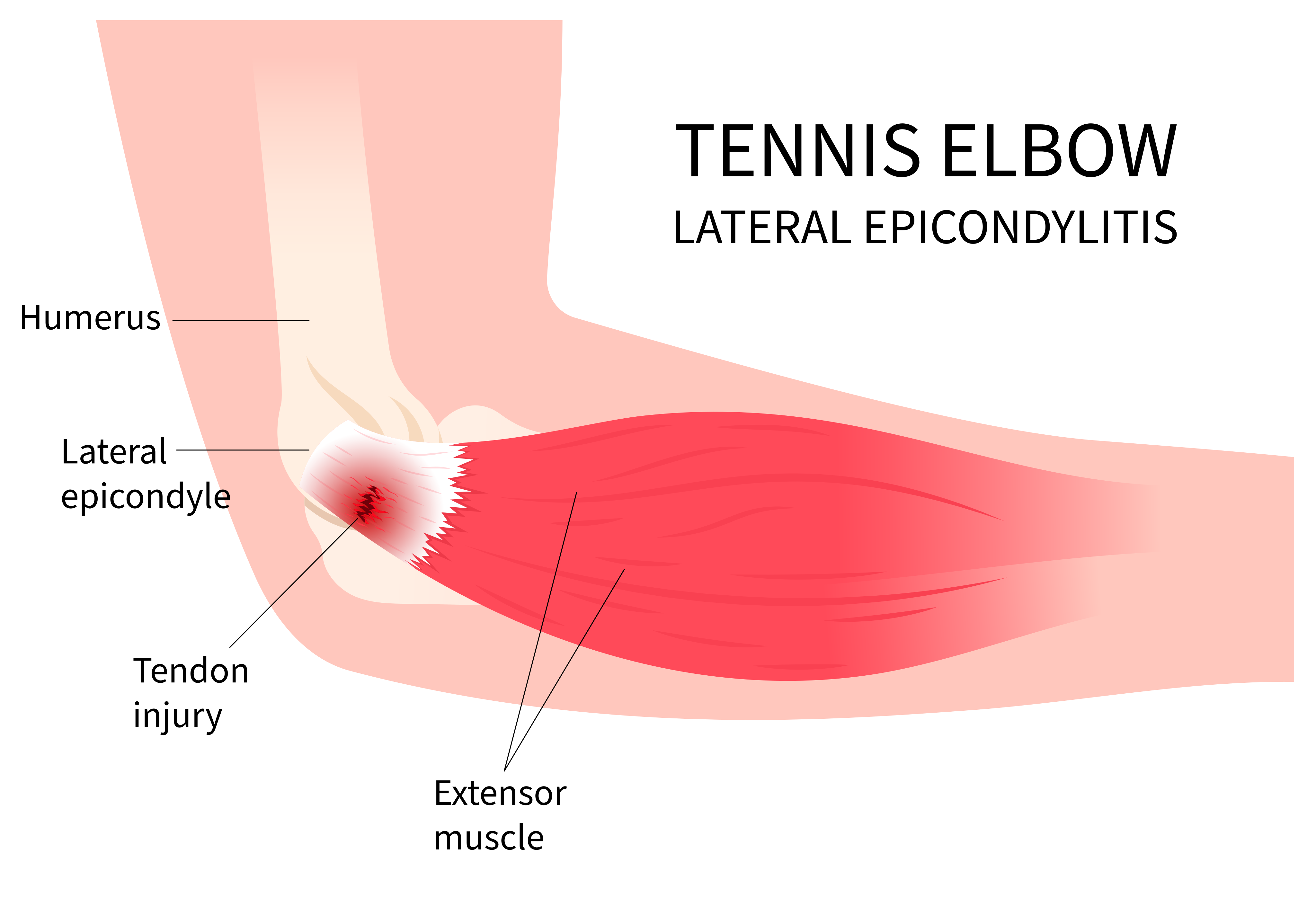
The ECRB (extensor carpi radialis brevis) originates at the lateral epicondyle. The degenerative zone sits just at this origin — the highest-stress point where the tendon transitions from bone to soft tissue. This is where the degenerative change develops and where pain is generated.
Tenderness is typically maximal just anterior and inferior to the lateral epicondyle — the anatomic footprint of the ECRB origin. Pressing on this spot reproduces the patient's pain precisely.
What It Feels Like
Tennis Elbow Symptoms
- Pain and tenderness on the outside of the elbow
- Pain with gripping, lifting or carrying
- Pain with resisted wrist extension
- Pain turning a doorknob, using a screwdriver or opening a jar
- A weaker grip, because gripping hurts
- Numbness or tingling is not typical of tennis elbow and suggests considering another diagnosis
Diagnosis
How Is Tennis Elbow Diagnosed?
Lateral epicondylitis is usually diagnosed from the history and examination. Pain is typically localized at or just distal to the lateral epicondyle and is reproduced by gripping or resisted wrist extension. Dr. Graham examines elbow and wrist motion, grip strength, the common extensor origin and surrounding structures to determine whether the findings are consistent with lateral epicondylitis and to look for other sources of lateral elbow pain.
X-rays, ultrasound and MRI are not routinely necessary when the history and examination are classic. Imaging becomes more useful when symptoms are atypical, have persisted despite treatment, or another source of lateral elbow pain is suspected. Ultrasound can evaluate the common extensor tendon for tendinosis or tearing, and MRI can be useful in selected refractory cases and for surgical planning.
Telling Them Apart
Tennis Elbow vs. Radial Tunnel Syndrome
Both conditions can cause pain on the outer side of the elbow, and they can occasionally occur together. Tennis elbow is usually most tender directly at the lateral epicondyle and common extensor origin, and is aggravated by gripping and resisted wrist extension. Radial tunnel syndrome pain is typically located farther down the proximal forearm along the radial nerve and may be aggravated by resisted forearm supination.
When lateral elbow pain does not behave like typical tennis elbow — or has failed appropriate treatment — Dr. Graham considers radial tunnel syndrome and other causes before recommending surgery.
Why You Found
So Many Different Treatments
When You Searched Online
If you've looked up tennis elbow treatment, you found a long list: cortisone, physical therapy, dry needling, ultrasound, massage, bracing, PRP, laser, acupuncture, shockwave therapy, surgery — and more. Tennis elbow has a favorable natural history but no single intervention reliably produces rapid, durable relief for every patient. That is why treatment options range from observation and rehabilitation to injections and, in selected refractory cases, surgery. Dr. Graham will be honest with you about that from the first visit, and offers reasonable options in a logical sequence.
Dr. Graham's Treatment Philosophy
A Comprehensive, Stepwise Approach
The goal is maximum relief for as long as possible. That means not relying on any single treatment — it means offering everything reasonable in a logical order and letting the patient guide how far to go.
Injection Option
Cortisone Injection —
Short-Term Pain Relief
Dr. Graham frequently offers a corticosteroid injection early in treatment, particularly when lateral elbow pain is substantially limiting work, activity, or rehabilitation. Cortisone can provide significant short-term pain relief, but it does not repair the degenerative tendon, and studies have not shown a durable long-term advantage over observation or placebo injection. Recurrence after an initially successful corticosteroid injection is also well recognized, so Dr. Graham generally avoids relying on repeated injections.
The injection is given in the office during a regular visit: the skin is numbed first, then the cortisone is injected together with a local anesthetic, in a single injection directly at the point of maximal tenderness at the lateral epicondyle. Relief often begins within days to a week.
When an injection is used, Dr. Graham typically pairs it with a progressive rehabilitation program rather than treating the injection as a stand-alone solution. In his clinical experience, the temporary reduction in pain can make the rehabilitation process easier for some patients, although this has not been established as a long-term benefit of corticosteroid injection in clinical trials. Clinically, Dr. Graham thinks of the injection as potentially opening a temporary “window” in which rehabilitation may be more comfortable — not as a treatment that heals the tendon itself.
Whether to repeat an injection depends on how much relief the first one gave, how long it lasted, and whether rehabilitation was completed. If an injection has not provided durable relief, PRP or surgery becomes a more appropriate next step.
Platelet-rich plasma (PRP) is prepared from the patient's own blood and delivers a concentrated platelet preparation to the abnormal tendon. Dr. Graham offers PRP as an option for patients who want to continue nonsurgical treatment before considering surgery.
The evidence is mixed. Some randomized-trial meta-analyses have found better longer-term outcomes with PRP than corticosteroid injection, while placebo-controlled analyses have not consistently demonstrated that PRP is superior to placebo. PRP is therefore an option — not a guaranteed tendon-healing treatment — and Dr. Graham discusses that uncertainty with patients before proceeding.
In Dr. Graham's experience, PRP is most often considered when symptoms remain limiting despite activity modification and rehabilitation, particularly when a patient wants to exhaust nonsurgical options before surgery.
The PRP injection for tennis elbow is performed in the office. The patient's blood is drawn, processed in a centrifuge to concentrate the platelets, and injected precisely at the ECRB origin under ultrasound or fluoroscopic guidance. PRP is intended to deliver concentrated platelets and growth factors to the degenerative tendon in an effort to influence the local healing response.
For patients interested in PRP, Dr. Graham's full PRP page has detailed information on the procedure, preparation, and what to expect.
When Conservative Treatment Isn't Enough
Surgery for Persistent Tennis Elbow
Surgery for lateral epicondylitis is offered after a genuine and committed trial of conservative treatment — cortisone, formal therapy, and in many cases additional modalities including PRP — has not resolved the pain to the patient's satisfaction. There is no hard rule about how long to wait; the conversation is about whether the patient has done enough to give conservative treatment a fair chance, and whether they are ready to move forward.
Observational surgical studies report high rates of pain relief and functional improvement after surgery for refractory lateral epicondylitis. High-quality comparative evidence is more limited. Dr. Graham therefore reserves surgery for patients with persistent, function-limiting symptoms who have given nonsurgical treatment a reasonable trial and understand the expected recovery.
The surgical procedure removes the degenerative portion of the ECRB tendon, detaches the tendon from the lateral epicondyle, and reattaches it using suture anchors. Dr. Graham uses the Nirschl scratch test as an intraoperative visual and tactile method to identify abnormal degenerative tendon and distinguish it from healthy tendon. The tendon is then secured to the bone with suture anchors.
- Persistent lateral elbow pain despite a formal course of cortisone injection and physical therapy
- Symptoms that persist despite genuine treatment attempts, not watchful waiting — there is no hard rule on how long to wait
- PRP has been tried or considered and has not achieved adequate relief
- Patient has realistic expectations — surgery produces pain relief, not an immediate return to full activity
- Patient is motivated to complete the post-operative rehabilitation protocol
- No other explanation for the lateral elbow pain — radial tunnel syndrome, cervical radiculopathy, or referred pain has been considered
Operative Technique
Detach, Debride,
& Re-anchor —
The Nirschl Approach
The surgical technique for lateral epicondylitis involves three essential steps: detaching the ECRB from its origin on the lateral epicondyle, removing the degenerative portion of the tendon, and reattaching the healthy tendon to bone with suture anchors. The goal is to excise the pathologic tissue while preserving the healthy ECRB and restoring its anatomic origin.
Dr. Graham uses the Nirschl scratch test as an intraoperative tool to identify the degenerative tendon. During the procedure, the degenerative tissue has a characteristic grayish, friable appearance and texture — different from healthy white tendon. The scratch test confirms which tissue should be removed and which healthy tendon should be preserved. Removing too little leaves pathologic tissue behind; removing too much sacrifices healthy tendon. The scratch test threads that needle.
After debridement, the ECRB is reattached to the lateral epicondyle using suture anchors, providing secure fixation while the tendon heals to bone. The construct is strong enough to begin hand therapy at 2 weeks post-operatively.
Named after Dr. Robert Nirschl, who described the procedure, the Nirschl scratch test identifies degenerative tendon tissue intraoperatively. Degenerative ECRB has a characteristic grayish, fish-flesh appearance distinct from the white, glistening healthy tendon. Dr. Graham uses this tactile and visual assessment to guide the boundaries of debridement precisely — removing the pathologic tissue while preserving everything healthy.
Anesthesia
Regional block — axillary or more proximal. Outpatient procedure. No general anesthesia required in most cases.
Incision and Exposure
Small incision centered over the lateral epicondyle. The common extensor origin is identified and the ECRB is separated from the extensor digitorum communis and isolated for inspection.
Tendon Detachment
The ECRB is detached from the lateral epicondyle to expose the degenerative tissue at its origin. The Nirschl scratch test is used to identify and delineate the degenerative zone — distinguishing pathologic gray tissue from healthy white tendon.
Debridement
The degenerative portion of the ECRB is excised. Healthy tendon is preserved. The lateral epicondyle is lightly decorticated to promote bleeding and enhance the biological healing environment for reattachment.
Suture Anchor Reattachment
The ECRB is reattached to the lateral epicondyle using Arthrex suture anchors, providing secure fixation. The construct is confirmed to be stable and anatomic before closure.
Splint and Recovery
Post-operative splint for 2 weeks. Custom-made orthosis for an additional 4 weeks. Hand therapy begins at 2 weeks. Full recovery: approximately 3 months.
Recovery After Surgery
Three Months to Full Activity
Recovery after tennis elbow surgery follows a structured rehabilitation protocol, with protection of the repair initially, followed by progressive motion and strengthening.
Post-Op Splint
Splint in place protecting the repair. Swelling management. Fingers and wrist are rested but grip is not prohibited. Wound check at 2 weeks.
Custom Orthosis + Therapy
Custom-made elbow and wrist orthosis. Hand therapy begins — gentle range of motion, tendon gliding, progressive loading. Orthosis worn during activity for protection.
Progressive Strengthening
Orthosis discontinued. Strengthening program advances. Progressive loading, grip strengthening, functional activities. Gradual return to work and sport activities.
Full Return to Activity
In Dr. Graham's protocol, many patients return to unrestricted activity around 3 months, although heavy manual work and demanding sports may take longer.
“Great doc! Very easy going which helps to keep patients calm and great sense of humor. He told me clearly that the damage to my elbow and wrist was bad and surgery could possibly not help BUT it did wonders and has stopped the chronic pain! Can’t go wrong with Dr. Graham!”
Common Questions
Tennis Elbow FAQ
Questions from patients who have been dealing with this problem for months and are trying to figure out what to do next.
References & Further Reading
The sources below informed this page and are good places to read further. Links open in a new tab.
- Lucado AM, Day JM, Vincent JI, et al. Lateral Elbow Pain and Muscle Function Impairments: Clinical Practice Guidelines. J Orthop Sports Phys Ther. 2022;52(12):CPG1–CPG111.
- Lapner P, Alfonso A, Herbert-Davies J, et al. Position Statement: Nonoperative Management of Lateral Epicondylitis in Adults. Can J Surg. 2022;65(5):E625–E629.
- Coombes BK, Bisset L, Brooks P, et al. Effect of Corticosteroid Injection, Physiotherapy, or Both on Clinical Outcomes in Patients With Unilateral Lateral Epicondylalgia: A Randomized Controlled Trial. JAMA. 2013;309(5):461–469.
- Ikonen J, Lähdeoja T, Ardern CL, et al. Persistent Tennis Elbow Symptoms Have Little Prognostic Value: A Systematic Review and Meta-analysis. Clin Orthop Relat Res. 2022;480(4):647–660.
- Xu Y, Li T, Wang L, et al. Platelet-Rich Plasma Has Better Results for Long-term Functional Improvement and Pain Relief for Lateral Epicondylitis: A Systematic Review and Meta-analysis of Randomized Controlled Trials. Am J Sports Med. 2024;52(10):2646–2656.
- Kholinne E, Singjie LC, Anastasia M, et al. Comparison of Clinical Outcomes After Different Surgical Approaches for Lateral Epicondylitis: A Systematic Review and Meta-analysis. Orthop J Sports Med. 2024;12(5):23259671241230291.


Medically reviewed by R. David Graham, MD · Reviewed 6 October 2026 · Board-Certified Orthopaedic Surgeon · Fellowship-Trained Hand & Upper Extremity Surgeon · Physician biography