
Triquetral Avulsion Fracture
Jacksonville, FL
A fall or twisting injury to the wrist produces pain on the ulnar (pinky) side, and the X-ray shows a small chip of bone on the back of the wrist. That's a triquetral avulsion fracture — the second most common carpal fracture after the scaphoid. Dr. Graham at JOI is direct about this: for the common isolated dorsal chip, treatment is usually very similar to treatment for a stable wrist sprain.
- Second most common carpal fracture after the scaphoid
- Usually a small dorsal chip, from a ligament pull or an impaction
- The common chip is treated much like a wrist sprain: brace and motion
- Surgery is rarely necessary for an isolated, stable dorsal chip
- An exam still matters: the same fall can injure the scaphoid or wrist ligaments
The chip looks alarming on X-ray but usually behaves like a sprain. What matters most is confirming it is the only injury.
A Chip Off the Back of the Wrist
What Is a Triquetral Avulsion Fracture?
This page addresses the common small dorsal cortical “chip” fracture of the triquetrum. Triquetral body fractures, displaced fractures, volar cortical fractures, and fractures associated with carpal instability are different injuries and may require additional imaging or surgical treatment. Telling them apart takes an examination and the right X-ray views, which is why even a small chip is worth having evaluated.
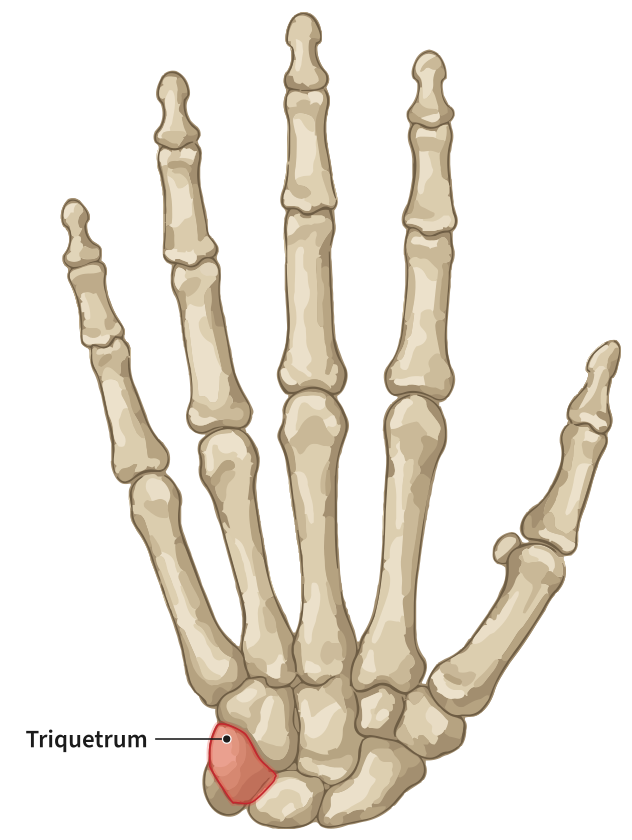
The triquetrum is one of eight carpal bones — it sits on the ulnar (pinky) side of the wrist, articulating with the pisiform in front and the hamate below. On the dorsal (back) surface, several ligaments attach to the triquetrum, including fibers of the dorsal radiocarpal and dorsal intercarpal ligaments. The small dorsal chip can result from ligament traction on the triquetrum or from impaction during a fall onto the wrist. Either mechanism produces the characteristic dorsal cortical fragment seen on X-ray.
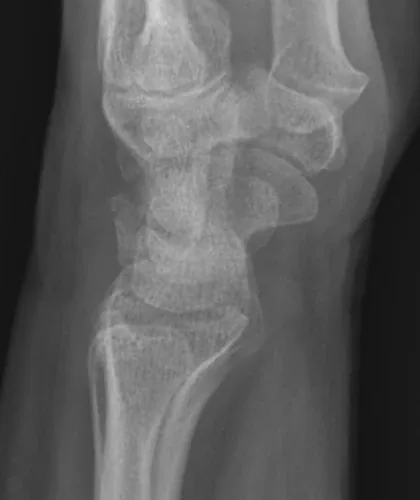
This is a triquetral avulsion fracture, the standard name for the dorsal chip whichever way it happened. It is treated very differently from a scaphoid fracture. The fragment is typically small, cortical, and extraarticular, and it rarely needs surgical fixation or a cast.
In Dr. Graham's experience, the common small chip is treated much like a wrist sprain: a removable brace for about 4–6 weeks, with motion started as symptoms allow. The chip itself rarely changes the management compared with a ligament injury at the same location.
The one caveat worth knowing: a triquetral avulsion fracture can occasionally be the visible sign of a larger wrist ligament injury — particularly if ulnar-sided wrist pain persists. The treatment section below explains how that is checked.
- ✓Triquetral avulsion: dorsal chip, ulnar side, extraarticular — brace and move it
- ✓Scaphoid fracture: anatomic snuffbox tenderness; may be occult on initial X-rays, and persistent clinical suspicion warrants advanced imaging
- ✓The small triquetral chip rarely needs surgery
- ✓Scaphoid nonunion can occur if missed — treatment urgency is completely different
- ✓Both can occur together in higher-energy wrist trauma
If there is any clinical concern for a concurrent scaphoid fracture — anatomic snuffbox tenderness — that concern is addressed specifically regardless of the triquetral finding. Dr. Graham generally prefers MRI when snuffbox tenderness remains concerning despite normal X-rays.
Symptoms & Diagnosis
Triquetral Avulsion Fracture Symptoms & Diagnosis
Symptoms. Pain and swelling on the back of the wrist, toward the pinky side, after a fall. The tenderness is focused over the back of the triquetrum, and moving the wrist hurts.
X-rays. The small chip is often easiest to see on a side (lateral) or angled (oblique) view, and it can be missed on routine films.
CT. Useful when a fracture is strongly suspected but the X-rays are inconclusive, or when the pattern needs to be clarified.
MRI. Most useful when symptoms persist and raise concern for an associated ligament injury, a TFCC injury, instability, or another injury not seen on X-ray.
The examination matters as much as the X-ray: the same fall can injure the scaphoid or the wrist ligaments, which are treated differently.
Treatment
Triquetral Avulsion Fracture Treatment: Brace, Motion & Reassurance
The common small dorsal chip is treated much like a wrist sprain because it usually behaves like one: a wrist sprain with a visible bony correlate.
Why Surgery Is Rarely Needed for the Chip
For an isolated, stable dorsal triquetral chip fracture, surgery is rarely necessary. The fragment is usually small and extra-articular, so it generally does not need to be reduced and fixed. The small fragment does not need to unite anatomically with the triquetrum to produce an excellent clinical result: sometimes it heals back to the bone, and sometimes it settles with firm scar tissue (a fibrous union), which is also stable. Patients sometimes arrive expecting a cast or surgery because a bone is involved; for this common chip, neither is usually needed.
For an isolated stable dorsal chip fracture, Dr. Graham generally uses a removable wrist brace rather than a cast. A 2025 study of dorsal triquetral chip fractures found favorable outcomes with nonoperative treatment and no significant outcome difference between a removable wrist orthosis and cast immobilization.
Why the Chip Is Usually Good News
In Dr. Graham's experience, when the chip is a ligament avulsion it is usually the reassuring version of this injury: the ligament appears to have pulled its bony attachment away rather than tearing through its own substance, and in most patients it heals back tightly with no lasting problem. A ligament injury without a chip worries him more. Still, a chip does not prove the ligament is otherwise uninjured, so persistent symptoms are rechecked. Very rarely, the ligament damage leads to instability in the middle of the wrist, called midcarpal instability.
The minor capsuloligamentous injury accompanying an isolated dorsal chip fracture usually responds to the same conservative treatment used for a stable wrist sprain. Persistent pain, clicking, weakness, or instability warrants reassessment for an associated ligament or TFCC injury. If ulnar-sided pain, weakness, clicking, or instability persists beyond the expected 6–8 week recovery period, Dr. Graham typically obtains an MRI arthrogram to evaluate for an associated LT ligament, TFCC, or other wrist ligament injury, including whether the ligament healed as expected.
Brace
Removable cock-up wrist brace. Pain managed with NSAIDs or acetaminophen. Activity as tolerated within pain limits.
Motion
Motion is started as symptoms allow, with formal hand therapy when stiffness, weakness, or loss of motion makes it useful. Brace weaned as strength returns. Most patients are comfortable without the brace by 4–6 weeks.
Reassessment
Most patients are clearly improving. If not, Dr. Graham reassesses for an associated ligament injury, as described above.
Return to Full Activity
Most patients have returned to unrestricted activity by this point. Some residual soreness or swelling can take longer to completely settle. Symptoms typically resolve even though the small dorsal fragment may remain visible on future X-rays. A painless fibrous union is common and does not require treatment.
FAQs
Frequently Asked Questions
References & Further Reading
The sources below informed this page and are good places to read further. Links open in a new tab.
- Guo RC, Cardenas JM, Wu CH. Triquetral Fractures Overview. Curr Rev Musculoskelet Med. 2021;14(2):101–106.
- Pasquinelli S, Tondelli T, Guenkel S. Treatment Modalities and Patient Reported Outcomes in Isolated and Combined Dorsal Triquetrum Chip Fractures. Eur J Trauma Emerg Surg. 2025;51(1):274.
- Okoro CK, Skalski MR, Patel DB, White EA, Matcuk GR Jr. Imaging Diagnosis and Management of Carpal Trauma and Instability—An Illustrated Guide. Life (Basel). 2023;13(7):1426.
Related Conditions


Next Steps
Dorsal wrist chip fracture —
brace, motion, and reassurance.
The common isolated dorsal triquetral chip fracture usually heals without surgery. If you've been told you have a chip fracture and you're uncertain about what to do next, Dr. Graham can confirm the diagnosis and get you started on appropriate treatment. Walk-ins welcome via JOI Now.
Jacksonville Beach, FL 32250
No prior imaging required to schedule an evaluation.
Medically reviewed by R. David Graham, MD · Reviewed 5 October 2026 · Board-Certified Orthopaedic Surgeon · Fellowship-Trained Hand & Upper Extremity Surgeon · Physician biography