
Jammed Finger —
PIP Joint Sprain
You jammed your finger. It's swollen, it hurts, maybe there's a tiny chip of bone on the X-ray. Here's what you need to know: most jammed fingers are stable sprains, and those do best with buddy taping and early motion. The first step is making sure yours isn't one of the exceptions. Prolonged immobilization of a stable PIP joint sprain is one of the most common ways to end up with a stiff finger. Dr. Graham at JOI generally prefers buddy taping and early active motion for stable injuries because this protects the joint while allowing it to move. The exception is a central slip injury, which needs a splint holding the middle joint straight — one reason a jammed finger is worth having examined.
- First, rule out the exceptions — central slip injury, instability, dislocation or fracture.
- Then, for a stable PIP sprain — buddy tape to the adjacent finger and begin early active motion.
- Begin gentle active motion throughout the day — avoid prolonged immobilization
- Small volar avulsion fracture? If the joint stays stable and aligned, it usually doesn't change the treatment. A follow-up X-ray confirms it stays that way
- Collateral ligament sprains: usually non-operative when the joint is stable — same treatment
- Prolonged immobilization of a stable PIP sprain can cause permanent stiffness — the joint becomes rigid before it heals
- Full recovery: weeks to months — swelling and soreness outlast the structural healing
The swelling and discomfort of a jammed finger can feel alarming enough to warrant immobilization. For a stable injury, it usually isn't. The PIP joint is particularly prone to stiffness — for stable injuries, buddy taping and early motion is the evidence-based and experience-based treatment.
What Actually Happened
What Is a PIP Joint Sprain?
The PIP joint — proximal interphalangeal joint, the middle knuckle of the finger — is the most commonly sprained joint in the hand. The PIP joint is particularly prone to stiffness after injury and immobilization, which is why early motion matters so much after a stable injury.
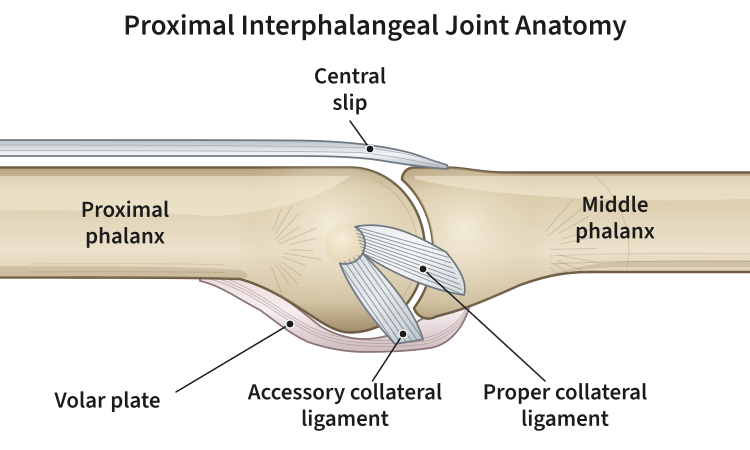
When a ball hits the fingertip or a finger is forced into axial compression or hyperextension, several structures can be injured simultaneously. The volar plate — a thick fibrocartilaginous structure on the palm side of the PIP joint that prevents hyperextension — is the most commonly damaged. The collateral ligaments on the radial and ulnar sides of the joint stabilize it against sideways stress. Both can be sprained in the same injury.
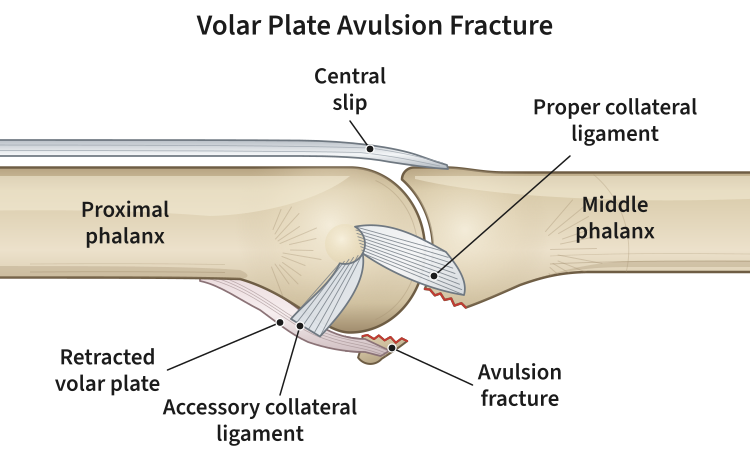
The PIP joint also has a characteristic associated fracture that can appear on X-ray and frequently causes alarm: a small avulsion fragment off the volar (palm-side) base of the middle phalanx, where the volar plate attaches. When the volar plate is forced into hyperextension, it can pull a small fleck of bone off its attachment. This looks dramatic on X-ray, but when the fragment is small and the joint stays stable, it behaves like the ligament injury it came with. A larger fragment, or a fracture with subluxation of the joint, is different and needs evaluation; the fracture section below explains how fragment size relates to stability.
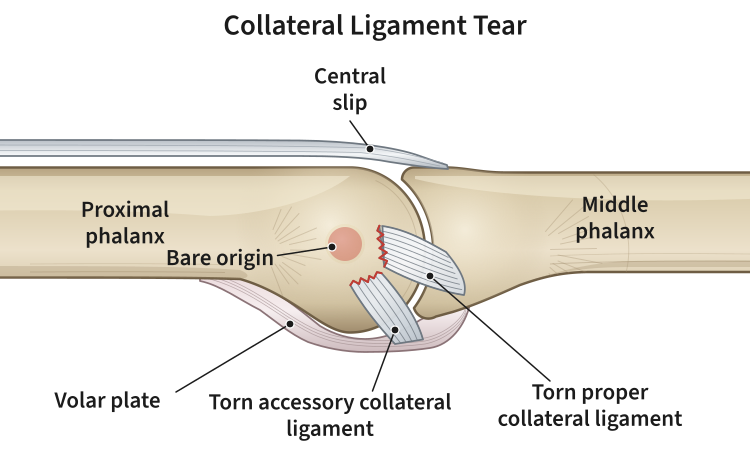
Collateral ligament sprains of the PIP joint follow the same principle: whether radial, ulnar, or both collaterals are injured, most are stable and heal without surgery. Complete collateral ligament tears with gross PIP instability are rare and warrant evaluation, but they represent a small fraction of PIP injuries.
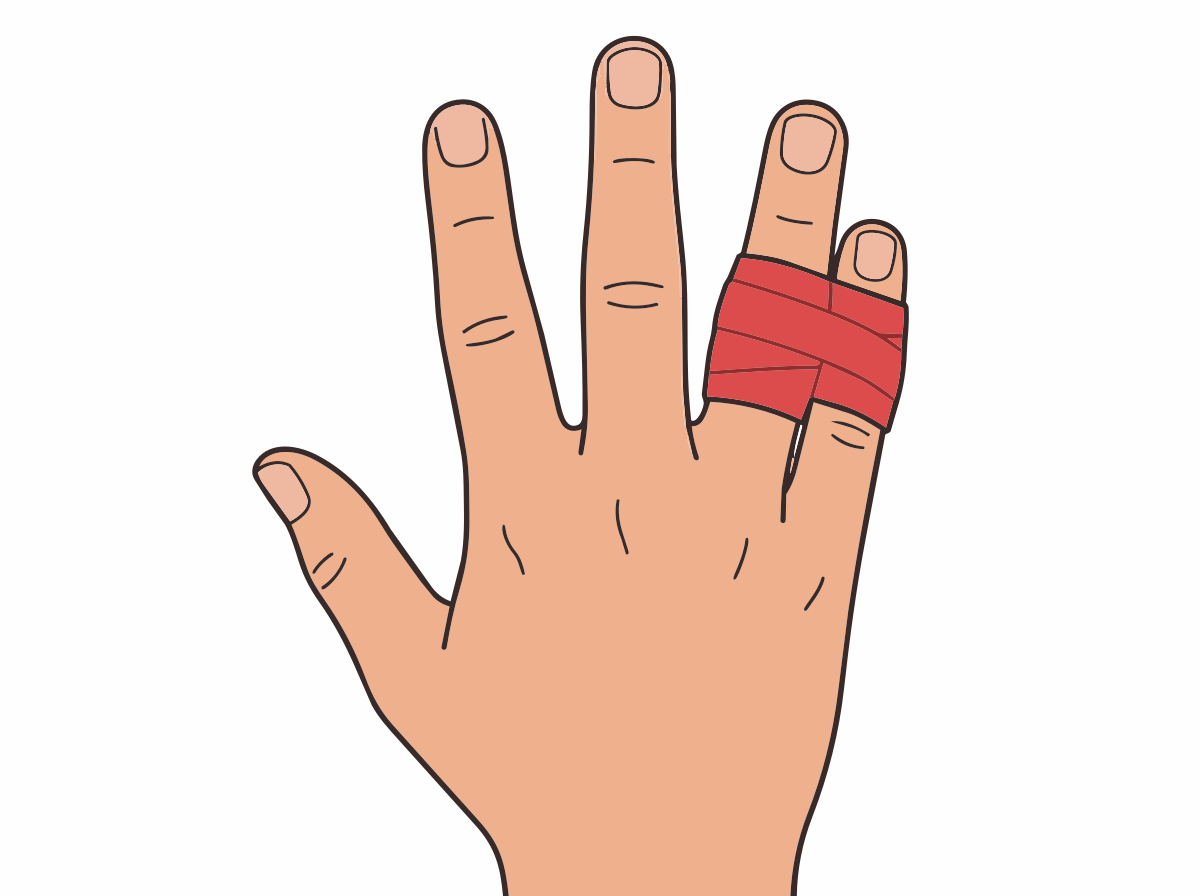
Tape above and below the PIP joint — leaving the joint itself free to bend. The buddy finger acts as a dynamic splint that allows motion while preventing sideways stress. Paper tape or athletic tape both work. Change when wet.
- →Joint looks visibly crooked or won't straighten
- →The finger crosses over your other fingers when you bend it — this likely indicates a fracture
- →Cannot bend OR straighten the finger at all
- →Significant bruising
- →Numbness or tingling in the fingertip
- →Joint grossly unstable — flopping sideways with light stress
- →X-ray shows a large fracture fragment or the joint is out of alignment (subluxed)
- →Swelling and pain are not improving at all after 2–3 weeks
Diagnosis
How Is a PIP Joint Sprain Diagnosed?
The diagnosis begins with the mechanism of injury and examination of the PIP joint. Dr. Graham looks for tenderness over the volar plate and collateral ligaments, checks whether the joint is stable to side-to-side stress, and evaluates active flexion and extension. X-rays are used to look for an avulsion fracture, dislocation, subluxation or a larger fracture involving the joint surface.
An important part of the examination is making sure the extensor mechanism is intact. A central slip injury can initially look like an ordinary jammed finger but requires very different treatment. Dr. Graham routinely assesses central slip function with an Elson test, a specific examination maneuver that tests the extensor mechanism across the PIP joint. If the finger is too swollen and painful for the test to be reliable, he will often bring the patient back to repeat it once the swelling settles.
The Injury Not to Miss
Central Slip Injury: The Jammed Finger That Needs a Splint
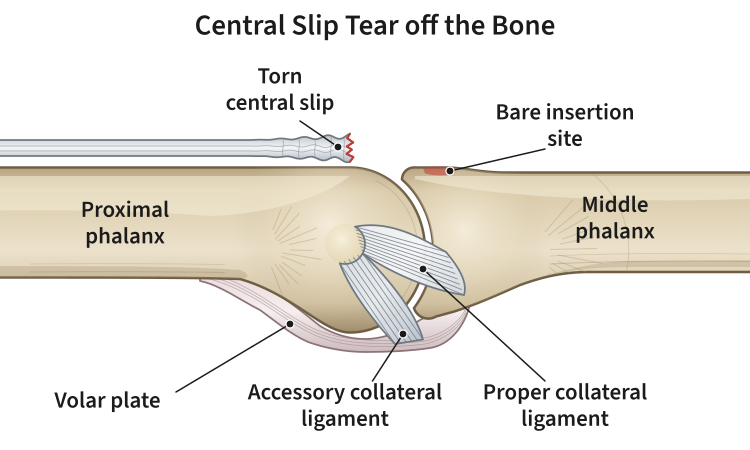
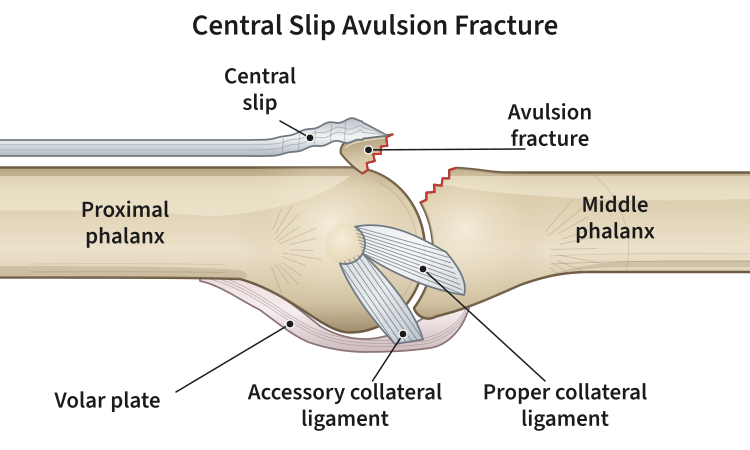
Not every jammed finger is a simple sprain. The central slip is the tendon that straightens the PIP joint, and the same jam can tear it off the base of the middle phalanx, sometimes pulling a small piece of bone with it. This is the exception to the buddy-taping advice on this page: a central slip injury needs a splint that holds the middle joint straight, usually for about six weeks. Missed, it can turn into a boutonnière deformity, where the middle joint stays bent and the fingertip bends back.
Central slip injuries can be subtle early, before a boutonnière deformity develops. One warning sign is a middle joint that will not fully straighten on its own, even if someone else can push it straight. That is one reason a jammed finger is worth having examined.
Sprain or Dislocation
Jammed Finger vs. Dislocated Finger: What's the Difference?
A “jammed finger” describes how the injury happened; the examination and X-rays determine whether the actual injury is a stable PIP sprain, volar plate injury, central slip injury, fracture, subluxation, or dislocation.
A jammed finger and a dislocated finger can result from the same type of force, but they are not the same injury. In a common stable PIP sprain, the volar plate or collateral ligaments are stretched or partially torn, but the joint surfaces remain normally aligned. With a more severe injury, those stabilizing structures can fail enough for the middle phalanx to partially shift out of position (subluxation) or completely lose contact with the joint (dislocation).
A finger that visibly popped out of joint and then went back into place — either on its own or when it was pulled straight — should still be considered a dislocation history. Even if the current X-ray looks normally aligned, the joint should be evaluated for associated fracture, ligament or tendon injury and post-reduction stability.
In that sense, many PIP sprains and dislocations can be thought of as different points along the same spectrum of joint injury. The important distinction is whether the joint ever lost its normal alignment and whether it remains stable after reduction.
A simple stable PIP sprain is generally treated with buddy taping and early active motion. A true dislocation requires reduction if it is still out of place, X-rays to confirm alignment and look for an associated fracture, and an examination of joint stability and the surrounding tendons and ligaments. Some stable dislocations ultimately transition to early protected motion as well, but they require different initial evaluation and often closer follow-up than a simple sprain.
When a dislocation comes with a fracture that leaves the joint unstable, it is a PIP fracture-dislocation, covered on the finger fractures page.
Scroll the table sideways to see all columns
| Feature | Stable PIP sprain | PIP dislocation |
|---|---|---|
| Joint alignment | Remains aligned | Joint surfaces have lost normal alignment |
| Ligament injury | Stretch or partial injury commonly | Greater capsuloligamentous disruption generally |
| Reduction needed | No | Yes, if still dislocated |
| X-rays | Evaluate for fracture and alignment | Confirm reduction and look for an associated fracture |
| Treatment | Usually buddy tape and early motion | Depends on stability after reduction; early protected motion when stable |
| Follow-up | Usually straightforward | Closer assessment of stability, motion and associated injury |
The Fracture on the X-Ray
Volar Avulsion Fracture — What It Means (and What It Doesn't)
You got an X-ray. There's a small chip of bone. The radiologist may have called it a volar plate avulsion fracture, a middle phalanx base fracture, or a volar lip fracture of the middle phalanx base. Here's what that actually means for your treatment.
What a Volar Plate Avulsion Is
The volar plate is a thick ligamentous structure on the palm side of the PIP joint that prevents the joint from hyperextending — bending backwards past straight. It anchors to the base of the middle phalanx. When a jam or hyperextension injury stretches the volar plate past its limit, it can pull a small fleck of bone off its attachment point at the base of the middle phalanx.
This chip is usually tiny — a few millimeters. It shows up clearly on X-ray, which makes it look more concerning than it is. The structural significance is that of the ligament injury itself — the bony fragment is the volar plate's attachment point, which is why a small one behaves like the ligament injury it came with.
What It Means for Treatment
A small fragment is by far the most common finding, and the presence of a small avulsion fragment usually does not change Dr. Graham's treatment when the joint remains stable and concentrically aligned (the joint surfaces stay centered on each other). When a volar avulsion fragment is present, Dr. Graham obtains a follow-up X-ray — often around 2–3 weeks — to confirm the joint remains aligned and the injury remains stable.
Fragment size helps predict stability. Small fractures involving less than roughly 30% of the articular surface are usually stable. Injuries involving approximately 30–50% require closer assessment because stability is less predictable, while larger fractures are more likely to be unstable. The key question is whether the PIP joint remains concentrically reduced through motion — not the fragment percentage alone.
Surgery is considered when the joint cannot be reduced or cannot remain stably and concentrically reduced, rather than simply because an X-ray fragment crosses a particular size threshold.
"The small volar avulsion chip worries patients because it looks like a fracture on X-ray. In a jammed finger with a stable, aligned joint, it is the X-ray correlate of a ligament injury — it doesn't need surgery, and it heals fine. We monitor it to make sure the joint stays aligned."
— R. David Graham, MD · Hand, Wrist & Elbow Surgery · Jacksonville Orthopaedic Institute
The Collateral Ligaments
Radial & Ulnar Collateral Ligament Sprains
A sideways force on the finger can sprain the collateral ligaments on the radial (thumb-side) or ulnar (pinky-side) aspect of the PIP joint.
The radial and ulnar collateral ligaments of the PIP joint prevent the finger from deviating side to side — they stabilize the joint in the same way the MCL and LCL stabilize the knee. A lateral force on the fingertip — getting hit while reaching for a ball, a sideways bend — sprains one or both. The clinical findings are point tenderness on the side of the joint that was stressed, swelling, and pain with lateral deviation stress testing.
In Dr. Graham's experience, stable PIP collateral ligament sprains do not need surgery. The ligament heals on its own when the joint is allowed to move, and the neighboring finger acts as a natural side support while it does.
The rare exception: a complete collateral ligament tear with gross instability where the joint deviates dramatically to one side under minimal stress, particularly if accompanied by a large avulsion fragment. These can occasionally require surgical repair. But this is not the typical jammed-finger collateral ligament sprain — it is a distinctly unstable injury that presents differently.
Why Prolonged Immobilization Can Cause PIP Joint Stiffness
This deserves its own section because it goes against every instinct. When something is injured and hurts, the reflex is to immobilize it. For a stable PIP injury, that instinct is wrong — and acting on it for weeks can cause permanent stiffness.
The PIP joint is particularly prone to stiffness after injury and immobilization. The joint capsule, volar plate, and collateral ligaments all thicken and contract when the joint is held in a fixed position for even a relatively short period. A stable sprain immobilized for 3–4 weeks can develop a flexion contracture that takes months of therapy to overcome — and in some patients, never fully resolves. A permanent stiff PIP joint from a jam that didn't need surgery in the first place is a known, preventable complication of over-treatment.
Buddy taping allows the finger to move while protecting it from re-injury. The adjacent finger provides lateral stability during daily activities. The patient actively bends and straightens the injured finger throughout the day. This is what heals a jammed finger with the best functional outcome.
If you've been immobilized for what was diagnosed as a simple stable PIP sprain and the finger is becoming increasingly stiff, it is worth having the diagnosis and treatment plan reassessed. Prolonged immobilization is usually avoided once the joint has been confirmed to be stable.
What to Expect
Recovery Timeline — It Takes Longer Than You Think
Jammed fingers heal — but they are notoriously slow to feel completely normal. Honest expectations help.
Acute Phase
Maximum swelling and pain. Ice for the first 48–72 hours. This is when early motion starts, even though it's uncomfortable.
Improving Motion
Swelling beginning to subside. Range of motion improving with active use. If a volar avulsion fracture was seen on X-ray, this is when the follow-up X-ray usually happens, to confirm the joint is still aligned.
Continued Recovery
The finger may still look swollen and feel stiff compared to the other hand — this is normal. Full range of motion and grip strength continue to improve. Daily motion exercises if stiffness persists.
Continued Recovery
Many stable PIP sprains feel substantially or essentially normal by this point, although swelling, joint enlargement or residual stiffness can persist longer. Some persistent enlargement of the PIP joint is common and can be long-lasting or permanent — the joint is structurally healed but may always be slightly larger than the other side. Once motion and strength have recovered, residual enlargement is often primarily cosmetic.
“You will not find a more caring and passionate physician like Dr. Graham! He makes sure to provide you with all the knowledge necessary to make an informed decision for your treatment plan. As Dr. Graham is very meticulous with his work, it gave me a peace of mind while proceeding with my treatment plan.”
Common Questions
Frequently Asked Questions
References & Further Reading
The sources below informed this page and are good places to read further. Links open in a new tab.
- Freiberg A, Pollard BA, Macdonald MR, et al. Management of Proximal Interphalangeal Joint Injuries. Hand Clin. 2006;22(3):235–242.
- Kamnerdnakta S, Huetteman HE, Chung KC. Complications of Proximal Interphalangeal Joint Injuries: Prevention and Treatment. Hand Clin. 2018;34(2):267–288.
- Paschos NK, Abuhemoud K, Gantsos A, et al. Management of Proximal Interphalangeal Joint Hyperextension Injuries: A Randomized Controlled Trial. J Hand Surg Am. 2014;39(3):449–454.
- Elfar J, Mann T. Fracture-Dislocations of the Proximal Interphalangeal Joint. J Am Acad Orthop Surg. 2013;21(2):88–98.
- Carruthers KH, Skie M, Jain M. Jam Injuries of the Finger: Diagnosis and Management of Injuries to the Interphalangeal Joints Across Multiple Sports and Levels of Experience. Sports Health. 2016;8(5):469–478.
Related Conditions
Also Treated by Dr. Graham


Next Steps
Jammed finger with a chip on X-ray —
most don't need surgery.
Most PIP joint sprains, including many with a small volar avulsion fragment, are stable and heal without surgery. If a finger immobilized for what was diagnosed as a simple sprain is getting stiffer, or you have concerns about alignment, Dr. Graham can reassess the diagnosis and the treatment plan. Walk-ins welcome via JOI Now, Monday–Friday.
Jacksonville Beach, FL 32250
Walk-ins welcome via JOI Now for finger injuries.
Medically reviewed by R. David Graham, MD · Reviewed 6 October 2026 · Board-Certified Orthopaedic Surgeon · Fellowship-Trained Hand & Upper Extremity Surgeon · Physician biography